Showing posts with label summer. Show all posts

Saturday, September 14, 2013

"Old Man's Beard"

Canon XTi with EF 100mm macro lens + macro-twin-flash;
exp. 1/125 sec., f/16, at ISO 100

Virgin's Bower
© Dave Spier

In the world of plants, there's a vine commonly known as "Old Man's Beard." (Well, that would apply to me, too, but I'm otherwise not green.) It's also called Virgin's Bower and botanists know it as Clematis virginiana, a member of the Anemoneae tribe in the Buttercup Family (Ranunculaceae). The descriptive name refers to the fruit clusters that have seeds ending in long filaments. Other folk names include Devil's Darning Needles and Devil's Hair. The genus name, Clematis, is Ancient Greek for "climbing plant."

The vine is somewhat herbaceous (at least in the north), meaning it dies back to the ground in late fall. It's opposite leaves have three leaflets reminiscent of Poison Ivy, but that is a woody vine. In the spring, Virgin's Bower has to start from scratch. In summer it puts out numerous clusters of small, fragrant flowers, each with four white "petals" (actually sepals). Compared to their colorful and showy garden relatives, they're more inconspicuous.

Virgin's Bower is native to eastern North America. Ours grow in a young woods that's mostly shaded. There they blend in with the other plants. Perhaps in full sun, the vines and flowers would be more noticeable. The vine is capable of climbing trees to a height of 20 feet, but ours just sprawl in a tangled mess across the top of the ground cover and low shrubs. Clematis virginiana tolerates Black Walnuts, which produce chemicals that interfere with some plant's growth. That's a good thing because the squirrels are advancing the walnut forest in that direction.

Corrections, comments and questions are always welcome at northeastnaturalist@yahoo.com or connect through my Facebook page and photo page. There's also a community-type page for The Northeast Naturalist. Other nature and geology topics can be found on the parallel blogs Adirondack Naturalist and Heading Out.

Wednesday, August 28, 2013

Giant Swallowtail


© Dave Spier
With a wingspan of roughly five inches (give or take an inch), the Giant Swallowtail (Papilio cresphontes, syn. Heraclides cresphontes) is one of the largest butterflies in eastern and southern North America. Females are larger than males.

This butterfly species ranges from Arizona to the East Coast and from southeastern Canada to Texas and Florida with a population extension into California. In the south the caterpillars are sometimes considered pests in citrus orchards. In the north the larvae eat Prickly-ash (a shrub unrelated to ash trees, although the compound leaves have a similar appearance). Common or Northern Prickly-ash (Zanthoxylum americanum) is in the citrus family (Rutaceae) and sometimes called "toothache tree" because the bark was chewed to relieve tooth-ache. Although I've found prickly-ash locally, its core range is the upper Mid-west.

Giant Swallowtails are dark brown to black with rows of pale yellow spots near the outer edges of all the wings and another row straight across the fore wings. The rear wing "tails" have yellow centers. Small orange and blue spots on the inner wing edges flank the abdomen tip.

Look for these butterflies in open areas and scattered woodlands, a perfect description of our yard where the butterflies check our garden flowers for nectar. The photo, however, was taken beside the Manchester Gateway Trail along Canandaigua Outlet Creek in the Village of Manchester, NY. It was visiting flowers in the open area under the high-voltage power lines. The rest of the trail is mostly wooded floodplain with deciduous trees.

There are several broods per year in the north, but the timing is variable from May to August or September.


Corrections, comments and questions are always welcome at northeastnaturalist@yahoo.com or connect through my Facebook page and photo page. There's also a community-type page for The Northeast Naturalist. Other nature and geology topics can be found on the parallel blogs Adirondack Naturalist and Heading Out.

Thursday, August 1, 2013

European Frogbit

Frogbit

© Dave Spier

Among its many incursions into southeastern Wayne County, New York, European Frogbit (Hydrocharis morsus-ranae) can be found edging Black Creek as it leaves the Montezuma Marshes west of Savannah, just before passing under Route 31 and flowing on its way to Crusoe Creek. This Eurasian species was introduced into Ottawa, Canada in the 1930's and has since spread around the lower Great Lakes and St. Lawrence Seaway watersheds. Its spread northeastward has been limited only by water salinity. There is no limit to the south and west, so it has reached Vermont, New York and Michigan. Frogbit can form dense colonies on the surface and threatens biodiversity by crowding out native species and shading underwater plant growth needed by fish. Its rapid growth also can clog waterways and hinder recreational activities such as boating, canoeing and fishing.
 

Frogbit resembles a miniature waterlily, but its small, pistilate (female) flowers have only 3 petals around a yellow center, unlike the showy native waterlilies with their numerous petals in concentric rows. The frogbit flower resembles those of arrowhead plants, which is not too surprising because both are monocots in the Order Alismatales (although they are in different families). The plant could survive very well without flowers, because its seeds contribute very little to its spread. Instead, the plant can hitch-hike on boats, while its winter buds (called turions) sink to the bottom and lie dormant until spring, when they rise and travel with water currents. The buds grow into complete plants which then enlarge by sending out runners (called stolons) which sprout additional plants in an expanding network that can interlock with adjacent colonies.
 
Frogbit's round, floating leaves (generally two inches or less in diameter), are often notched like water-lilies and grow in rosettes (i.e., radiating from a center point). Dangling roots (to 12 inches long) seldom anchor in the bottom mud, allowing mobility on surface currents, even blowing upstream.

European Frogbit can be distinguished from its native counterpart (Limnobium spongia) by checking the leaf stems. American Frogbit has a midline groove.


Corrections, comments and questions are always welcome at northeastnaturalist@yahoo.com or connect through my Facebook page and photo page. There's also a community-type page for The Northeast Naturalist. Other nature and geology topics can be found on the parallel blogs Adirondack Naturalist and Heading Out.

Thursday, July 18, 2013

Canada Thistle


Beware of tall, attractive wildflowers with prickly leaves growing in fields. Most have beautiful magenta or lavender-colored heads, but the leaves, and sometimes the stems, are edged with numerous, sharp spines to defend against herbivores looking for an easy meal. These are the thistles. They are composites, related to daisies and goldenrods in spite of the obvious differences. Most are biennials, starting as a ground-hugging rosette of prickly leaves the first year, then growing tall and flowering the second.
 

The Canada Thistle (Cirsium arvense), a misnamed alien invasive from Europe, is one of the less-obvious species here [in the northern Finger Lakes region of NY] because its light-purple heads are less than an inch high. The whole plant grows four to five-plus feet high and often forms dense colonies after spreading by underground stems. In Europe and northern Asia, it is known as Creeping Thistle. One plant's roots can spread to a three-foot diameter (or more) in one year and continue growing at this rate for many years, making it a difficult plant to eradicate. A single thistle plant can be considered biennial, but the root system is perennial and continues to put its energy into new clonal [cloned] shoots.
 
Canada Thistles form colonies from a spreading underground
 root system. Less energy goes into producing flowers.
Less energy goes into producing flowers which are usually dioecious (either male or female). Male flowers may be slightly smaller, but otherwise similar. Both are very fragrant, which is energy spent to attract pollinators and NOT humans. Female flowers produce 40 to 80 seeds per head, but the fuzzy pappus is loosely attached and often ineffective in seed dispersal.

Canada Thistle's main stems are smooth, but the deeply-lobed leaves are designed to keep you at a distance. In the spring, wear heavy gloves and protective clothing so you can return to the location and collect the young leaves, young stems and roots for food. One of the plant's nicknames is "lettuce from hell" (and it actually is related to lettuce). After removing the spines, add young leaves to salads or eat them cooked. The pithy, young stems are easier to deal with; just peel and eat raw or cooked. The roots of first year plants, before the tall stems begin, are a survival food, but they also can cause flatulence.

A crab spider is camouflaged against a Canada Thistle flower bud.

Canada Thistle is also food for wildlife, especially goldfinches and other finches that eat the seeds. Some butterfly and moth larvae eat the leaves. Look for Red Admirals, Viceroys and Painted Ladies on this thistle. The larvae of the Orellia ruficauda fruit fly parasitize the fertile seed heads, making them a somewhat-effective biological control.

In the past, a tea made from the leaves was used as a general tonic (stimulant) and diuretic to increase the loss of water from the body. Externally, it was used for skin sores and poison-ivy rash. Native Americans used a root tea as a digestive tract stimulant and dewormer. (I wonder what they used before Europeans introduced this wildflower.) At the other extreme, it was said to cause inflammation and irritation (Jacobs and Burlage). Go figure.


Cirsium comes from the Greek word, kirsion, from kirsos, a "swollen vein" remedied by one of the species in that genus. The species name, arvense, is Latin for "in the field." Among its other common names are "field thistle," "perennial thistle" and "cursed thistle." It was originally native to the Mediterranean and southeast Europe and likely arrived in North America during the 1600's.

Corrections, comments and questions are always welcome at northeastnaturalist@yahoo.com or connect through my Facebook page and photo page. There's also a community-type page for The Northeast Naturalist. Other nature and geology topics can be found on the parallel blogs Adirondack Naturalist and Heading Out.

Wednesday, July 10, 2013

Ash-tree Bolete

Ground-level view of an Ash-tree Bolete cluster on a grassy trail

Mushroom species are seasonal in nature, much like wildflower species, but unlike plants, they do not require sunlight. For most of the year, they are underground or growing inside dead wood or otherwise out of sight. Rain is good for mushrooms and this year holds promise of an abundance in the Northeast, both in number of species and a surplus of each type. When mushrooms "suddenly" appear, what we see are just the fruiting bodies with the sole function of releasing spores (think evolutionary predecessors to seeds). They will drift on the wind and those that find suitable landing pads will develop into new, hidden networks underground or inside rotting logs, and these may last for years.
 

Top and bottom of Ash-tree Bolete caps.

While the familiar mushrooms have radiating gills that produce the spores on the undersurface of the caps, Boletes are a family of mushrooms (Boletaceae) that have a spongy layer of pores or tubes on the underside to do the same job. Boletes are soft, fleshy and stalked and often grow in the woods. Many of the 200 North American species are edible, but only a few are worth the effort of collecting, and several are poisonous, so beware.
 

Angular pores radiating away from the stalk at the edge of a cap.

Where do you think Ash-tree Bolete (Boletinellus merulioides) grows? (one guess) Well, true to its name, in our yard it grows on the grassy and moss-covered trails under the ash trees. Numerous brown caps, averaging three to four inches across, are growing either singly or in tight clusters. The older ones are wavy-edged and distorted. On the yellow underside of each cap, a network of irregular ridges and cross-ribs creates a fine pattern of angular, shallow pores giving this mushroom the nickname, "shallow-pore." The thin folds can appear almost gill-like as they radiate away from the off-center stalk. (Sometimes the stalk is lateral, or attached at the edge of the cap.) If bruised, the pores turn blue-green, then reddish-brown. Beware, some of the toxic Boletes are blue-staining.
 

A row of Ash-tree Boletes on a grassy trail under a grove of ash trees.

Ash-tree Bolete (also called Boletinus porosus and Gyrodon merulioides in some field guides) grows from Michigan to Eastern Canada and south to Texas and Florida. This species is edible, but not recommended, partly because of the chance of confusion with several toxic boletes. That risk aside, the quality and flavor are said to be poor, at least in comparison to better mushrooms.

It's likely a snail scraped part of the right cap to make a meal.
The left cap is turned over to show the underside pores.
Corrections, comments and questions are always welcome at northeastnaturalist@yahoo.com or connect through my Facebook page and photo page. There's also a community-type page for The Northeast Naturalist. Other nature and geology topics can be found on the parallel blogs Adirondack Naturalist and Heading Out.

Sunday, July 7, 2013

Black Raspberries

Yummy

I have mixed feelings about early July. On the down side are the humidity and the mosquitos (which seem to have reached a new peak). On the positive side, the wild Black Raspberries are ripe. For years, I've been encouraging these bushes to grow around the perimeter of our property. Even though they're thorny and often hook me on the arm or in the hair, the rewards seem to be worth it.

Black Raspberries are native to eastern North America.

The common species is Rubus occidentalis, but similar varieties are numerous. They belong to the rose family, making them direct relatives of blackberries, strawberries, rose hips, cherries, plums, apples and pears. They are nicknamed "black caps" or "thimbleberries," referring to the way the ripe fruit separates easily from the pedicel leaving a round button called a carpel or receptacle (which seems misleading). True blackberries, a distinctly-different species, do not separate from the receptacle. Individual raspberry fruits are composite clusters of small beads called drupelets, each containing a tiny seed. The dark-purple color is produced by anthocyanin pigments which makes them useful as natural dyes -- witness the color of your fingers after picking a few. Raspberries are also healthy. The anthocyanins are powerful antioxidants and are being tested for their effect on cancer.
 
Raspberry canes have a whitish, powdery bloom, best seen at upper left
It takes raspberry canes a year and a half to mature and bear fruit. The first year, the canes (green with a whitish, powdery coating) bear compound leaves usually with three leaflets but sometimes five arranged palmately (like fingers or spokes from a single point). The undersides of the toothed leaflets are silvery white, much like Silver Maple leaves. The second year, the canes turn dark purple or reddish, but the remaining powder makes them look bluish. They send out short branches that produce alternate, compound leaves with only three leaflets (unfortunately resembling poison ivy). Flowers with five white petals appear in May and these develop into red fruits which turn dark as they ripen around July 4th, give or take, here in the Finger Lakes region of New York. After the fruit is gone, you can still use the leaves to make tea.

The undersides of Black Raspberry leaves [turned over at right] are nearly white.

The arching canes may root at the tip if they touch the ground. In this way, one shrub can form broad colonies that provide protective cover for small mammals. During the winter, the canes of all brambles (including dewberries, black and red raspberries and true blackberries) become food for cottontail rabbits. Canes die at the end of their second year, but the roots continue to send up new shoots every spring.

Black Raspberries are native from Wyoming to Ontario and Quebec and south to Georgia and Mississippi. If you live in this area and want to collect raspberries, you need to get to them before the songbirds, game birds and wild mammals of all sizes. If you want to grow your own, they tolerate a wide variety of conditions from open sunlight to shade and soils that are moist or dry. They will grow in open woods, thickets, stream banks, wet meadows and old fields as well as the edge of your lawn. If you leave a spot around some trees unmowed, the birds will probably drop some seeds and help you get started. In two years you'll be on your way to healthy eating.

Corrections, comments and questions are always welcome at northeastnaturalist@yahoo.com or connect through my Facebook page and photo page. There's also a community-type page for The Northeast Naturalist. Other nature and geology topics can be found on the parallel blogs Adirondack Naturalist and Heading Out.

Friday, June 28, 2013

Black Elderberry

Elder usually has seven sharply-toothed leaflets,
but the number can vary from five to 11.
© Dave Spier

Common Elder, a.k.a. Black Elderberry (Sambucus canadensis, syn. Sambucus nigra, ssp. canadensis) is a native member of the Honeysuckle family. Beyond the opposite, pinnately-compound leaves, there's little resemblence to indicate the relationship. 

Numerous, small, white flowers are crowded into flat-topped terminal disks that are conspicuous in late June and early July in New York. The flower clusters can be dipped in batter and deep-fried like fritters, or wait for the dark-purple, juicy berries to ripen and make a pie. The dark fruits give the shrub it's alternate name, American Black Elderberry. Aside from the mentioned edibility, take note that the leaves, twigs, roots and unripe fruit are toxic due to cyanogenic glycoside and alkaloid.

The woody stems contain white pith that can be removed in order to make a flute or whistle. This musical quality is the basis of the genus name; in ancient Greece, sambuce was a musical instrument. Given the toxicity of the stems, though, I'd rethink this use for the plant.

Common Elder's range spans all of the southern states from California to Florida, north across most of the Lower 48 (except the Great Basin and Pacific Northwest) and continues north into eastern Canada. There's a range map on the USDA Plants Database. Many of the states have more detailed maps down to the county level. For example, the opening photo was taken at Newtown Battlefield State Park, near Elmira, NY, but the shrub occurs in other scattered locations across New York State.

This elderberry seems to require more sunlight than it's woodland cousin the Red-berried Elder, so look for the purple-fruited species on the edge of woods, usually in lowland spots where there is extra soil moisture, although I would not describe it as a true wetland species because of its low anaerobic tolerance. We live on top of a drumlin ridge and a Common Elder has "volunteered" to grow behind the garage where it is somewhat sunny, at least part of the day. We can assume the original seed was dropped by a bird. A number of species including robins, catbirds and waxwings are berry eaters. I'd be interested in knowing whether elderberry grows near you.

Corrections, comments and questions are always welcome at northeastnaturalist@yahoo.com or connect through my Facebook page and photo page. There's also a community-type page for The Northeast Naturalist. Other nature and geology topics can be found on the parallel blogs Adirondack Naturalist and Heading Out.

Wednesday, June 12, 2013

Yellow Warblers


Many warblers have at least some yellow, but I imagine if there's one that deserves the name of the color, it's the Yellow Warbler (Setophaga petechia).

The spring migration has come and gone, and now we have to be content with the summer residents that remain. Robins seem to be everywhere, and unfortunately so are the starlings and grackles. High in the tree tops, you might hear an oriole; they seem to prefer big cottonwoods here. If you have orioles near you, what trees do they prefer?  Orioles can be relatively common, but seldom do we get a good look at the male's flashy orange and black.
 

male Yellow Warbler at the Allegany Nature Pilgrimage (southwestern New York,
always the first weekend after Memorial Day) during a bird-banding demonstration

Another colorful songster, though relatively common, is likely to be overlooked unless you’re in the habit of scanning shrubby wetlands and thickets while listening for its "sweet, sweet, sweeter than sweet" song. Check the tops of shrubs and dwarf willows for a bright but tiny spot of yellow. With binoculars, look for rusty-red streaking on the breast. This is the male Yellow Warbler, one of 51 North American species of wood warblers – many of which are now uncommon or quickly pass through on their way north. The Yellow Warbler on the other hand is relatively common and a widespread nester from coast to coast across the northern 2/3rds of the U.S., Alaska and most of Canada with breeding populations extending down through coastal California and central Mexico. (If you're submitting an eBird report, you can use the "Add Details" button, and then the "Breeding Code" button to record any breeding behavior you observe or hear.)
 

female Yellow Warbler at Montezuma National Wildlife Refuge, NY

Warblers are small birds, generally four to five inches long, with slender, straight-pointed bills used like tweezers to collect insects. Warblers are very active and it’s hard to get a good look at any of them. Most prefer woodlands in various stages of growth from scrub to mature forest and for this reason they are referred to as wood warblers. Within these habitats, some warblers stay in the treetops (giving birders "warbler neck"), some hide on the ground and the majority travel in-between. Yellow Warblers are somewhat unusual in preferring more open settings. Willow thickets and isolated shrubs in cattail marshes seem more to their liking, but any thicket will do in a pinch.

male Yellow Warbler checking its reflection for a rival in our camper window

The Yellow Warbler is a common summer resident that begins returning at the end of April. The remainder trickles in throughout May. Aptly named, they are yellow on the head and underneath, olive-yellow on the back, and a mix of olive and yellow on the wings. Males are brighter with reddish streaks on the breast. The more aggressive and dominant males have darker streaks. Females are duller with faint rusty streaks on the sides. If you get a close view, look for yellow tail spots that are usually missed.

Brown-headed Cowbird egg in Yellow Warbler nest (Bradford County, PA)

The Yellow Warbler is one of the species most frequently parasitized by cowbirds, but they have developed a defensive strategy against the blackbirds. After a cowbird egg is deposited, the Yellow Warbler builds a new nest on top of the old and lays a new batch of their own eggs. If the cowbird returns, the warbler repeats the process. The record is a six-story nest (although there is an unconfirmed report of a 10-story nest near Cayuga Lake, NY, in 1923).

As a species, the Yellow Warbler is perhaps the most widespread of the warblers, but there are three distinct groups with four subspecies. Together they span the continent and range from the Arctic down through Mexico and the Caribbean to the northern reaches of South America. You can find an interactive range map on eBird.
 
pair of Yellow Warblers at Montezuma National Wildlife Refuge, NY

On their territories, Yellow Warblers sing two types of songs with a number of individual variations. One song type is used to attract a mate, while the other is used to defend territories against other males. With wetlands being a limited resource, there is intense competition for prime nesting space. After mating, recognition of individuals becomes important, so minor variations in songs become important. You can find more information along with a static range map and recordings of Yellow Warbler songs on All About Birds.
 

Yellow Warblers have only one brood per year and as soon as the young are independent, the species begins its southward migration. They are one of the earliest summer nesters to leave. Some are gone by the end of July and (almost) all have left by the time goldenrod is in full bloom.

Corrections, comments and questions are always welcome at northeastnaturalist@yahoo.com or connect through my Facebook page and photo page. There's also a community-type page for The Northeast Naturalist. Other nature and geology topics can be found on the parallel blogs Adirondack Naturalist and Heading Out.

Saturday, May 11, 2013

Shagbark Hickory

emerging hickory leaves can sometimes resemble praying hands
 © Dave Spier

A week of warm weather has created a green paradise in the northern Finger Lakes region of New York. Among the many transformed deciduous trees, the Shagbark Hickory (Carya ovata) leaves have emerged. When the giant bud scales first peeled open, the "fingers" of miniature leaves resembled "praying hands." Once fully opened, the hickory's feather-compound leaves become distinctive. There are five (sometimes seven) leaflets with four opposite and one at the tip. The smallest are the inner, the middle pair are larger and the terminal leaflet is the largest. All are toothed and long-pointed. By the time it's done growing, a compound leaf can reach over a foot in length.

young hickory leaves unfolded and growing


hickory flowers are wind pollinated

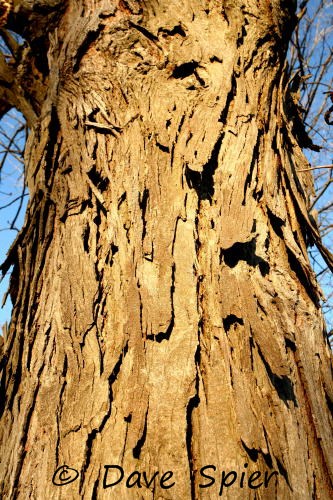
Shagbarks, aptly named for the long, peeling shreds of bark, can easily grow to a height of 60 to 90 feet. The record is 120 feet. The wood is strong and elastic and was once prized for tool handles, gunstocks, skis and chair backs. When burned, it gives off a lot of heat and makes high-grade charcoal.

Shagbark Hickory bark
In late summer and early fall, the thick-walled nut husks split into four sections and release the four-ridged nuts which are good to eat. (Squirrels, possums, Wild Turkeys and Wood Ducks would agree.) The nuts also can be ground in a meal-like flour or crushed and boiled to separate the oil. Rabbits and deer browse the twigs. In late winter, the trunks can be tapped in the manner of collecting maple sap.

child holding hickory nuts, some with the husk on (Bayberry Environmental Education Center, Junius, NY, when I was a naturalist there)

Hickories are related to walnuts and butternuts (Juglans spp.) which have numerous leaflets, all roughly the same size. All these trees are in the same family (Juglandaceae) along with pecans.


Corrections, comments and questions are always welcome at northeastnaturalist@yahoo.com or connect through my Facebook page and photo page. There's also a community-type page for The Northeast Naturalist. Other nature and geology topics can be found on the parallel blogs Adirondack Naturalist and Heading Out.

Sunday, September 16, 2012

Bur-marigolds

Bur-marigolds at the Montezuma Audubon Center, Savannah, NY, in September

Check your local damp meadows and marsh edges for a golden haze of beautiful, yellow, native wildflowers called bur-marigolds (Bidens species). Resembling small sunflowers, the bright-yellow flowers have an average of eight rays around a central disk. Not surprisingly both the sunflower and bur-marigold are in the Aster (or Composite) family.

Two species may occur in New York. The Showy, or Larger, Bur-marigold (B. laevis) has rays longer than a half inch and flower heads up to two inches in diameter. This species is found mainly from California across the lower (southern) states, and locally into the Midwest and also New York along the Lake Ontario plain. Apparently it's also widespread along the East Coast to Massachusetts.  A second species, Nodding Bur-marigold (Bidens cernua) has smaller yellow flowers that nod as they ripen.  It is widespread across Canada and the continental states except the Southeast and it's the more-likely species in New York, especially the Finger Lakes Region. Both species have opposite leaves that are narrow, long-pointed and toothed along the margins. The leaves of B. cernua are sessile (stalkless) and hug the often-rough stems.  B. laevis is smooth-stemmed with leaves that narrow (taper) at the base. The Finger Lakes Native Plant Society has an excellent species profile on their website.

Bur-marigolds also are known as beggar-ticks and stick-tights, referring to the sharply three-pronged seeds [achenes] that stick to clothes as you brush by a ripe plant.  The numerous seeds are eaten by upland and aquatic birds.

Additional reference:
Newcomb's Wildflower Guide, by Lawrence Newcomb and Gordon Morrison (© 1977), published by Little, Brown & Co.

Corrections, comments and questions are always welcome at northeastnaturalist@yahoo.com or you can connect through my Facebook page at Dave Spier (photographic naturalist) or my personal page, Dave Spier with the profile photo of me birding through a spotting scope. There's a new Fb page for The Northeast Naturalist.

Thursday, September 13, 2012

Flowering Rush


At first glance, the individual flowers resemble lilies, and that wouldn't be too far off. Lilies and Flowering Rush (Butomus umbellatus) are both monocots, meaning that their seeds sprout with one initial "seed-leaf" and not two like dicots. The flower heads of Flowering Rush resemble those of chives and onions which makes perfect sense because onions are really lilies. The clusters are in arrangements called umbels (think "umbrella"); all of the flower stems radiate fom a single point at the top of the main, cylindrical stalk. Queen Anne's Lace (Wild Carrot) flowers also grow in umbels, but that plant is a dicot with deeply-dissected, feather-veined leaves.

The leaves of Flowering Rush are narrow, long-pointed and sword-like with parallel leaf veins, again similar to chives and other dicots, but it's somewhat misleading because Flowering Rush is in a plant family of its own. (In fact it's the only genus and species in that family.) It's capable of growing to a height of five feet, under the right conditions, with leaves up to 40 inches long. Most of the time it grows more in the one to four-foot height range.


Flowering Rush is an alien growing on muddy shores along the St. Lawrence Seaway and it has spread to Lake Champlain and the Great Lakes and beyond. It's a Eurasian species brought here as an ornamental in the early 1900's, and it continues to spread from Vermont to Washington and adjacent Canada.

The flowers are rather attractive with three pink and white petals alternating with three smaller pink sepals. In the center are nine pink-and-white male stamens in a radial pattern around six magenta female pistils.

Like all invasive species, it competes with desirable native wetland species, and once started, Flowering Rush is hard to irradicate because the trailing rhizomes spread under the mud and pea-sized bulbils detach, disperse in the water and quickly germinate into new plants. Varieties of this plant growing in the east also produce seeds that can spread on water currents.

There are many desirable native substitutes for Flowering Rush, including Sweet-flag, Northern Blue-flag, Pickerelweed, Giant Bur-reed, Lake Sedge, and Hardstem Bulrush. Blue-flag and Pickerelweed are attractive personal favorites.


Corrections, comments and questions are always welcome at northeastnaturalist@yahoo.com or you can connect through my Facebook page at Dave Spier (photographic naturalist) or my personal page, Dave Spier with the profile photo of me birding through a spotting scope. There's a new Fb page for The Northeast Naturalist.

Wednesday, September 12, 2012

Marsh Wrens


As a group, wrens are small, noisy, brown birds that often hold their short tails upright.  Their bills are thin and curve down to a point for picking and eating insects and spiders.  The House Wren is the most familiar; it is plain brown and nests in tree cavities or nest boxes, often in proximity to human dwellings.

Its cousin, the Marsh Wren (Cistothorus palustris) lives – where else – in cattail marshes.  Its gurgling, rattling trill can be heard any time of day or night.  (If you think you might have heard this wren, you can listen to a recording of its song on the All About Birds website.)  On rare occasions when it perches on a cattail top in the open, you’ll notice a dark cap and light line above the eye.

During breeding season, nests are lashed to vegetation and sometimes hidden in shrubs.  Construction includes a woven dome of grasses and sedges with the entrance on side.

The Marsh Wren population is declining in the east, but increasing in the west.  Major differences in the two subspecies’ songs may indicate two separate species.  The combined winter range extends along the Gulf coast into the Southwest and down through all of Mexico.  A year-round population hugs the east coast from the Mason-Dixon line [the Pennsylvania/Maryland border] south to Florida. During migration, a Marsh Wren can stop in any of the lower 48 states.

The Marsh Wren photo was taken September 3rd from the dike separating the two main impoundments at the Montezuma Audubon Center north of Savannah, New York, where they can be heard, and sometimes seen, throughout the late spring, summer and early fall. You can get an idea of their seasonal distribution (and all the other species) in the Wetlands Complex by looking at the eBird bar chart for Wayne and Seneca Counties, New York.

On Saturday, September 29, there will be an organized canoe trip in the Montezuma Wetlands Complex from 2 pm – 4:30 pm.  Join the Montezuma Audubon Center’s Teacher-Naturalist, Frank Morehouse to explore the Seneca River along Howland’s Island, New York.   Learn about the birds and other wildlife of the area on a leisurely paddle.   There is a fee; canoes, paddles and life jackets will be provided (and binoculars if needed).   Bring water and snacks.   Pre-registration is required by calling (315) 365-3588 or email montezuma@audubon.org for details. The MAC website is http://ny.audubon.org/montezuma

Canoeing the Seneca River around Howland's Island, New York (file photo taken July 9th)  - © Dave Spier

Corrections, comments, questions and suggestions are always welcome at northeastnaturalist@yahoo.com  and on Facebook and The Northeast Naturalist.

Saturday, September 8, 2012

M.A.R.S.H.


M.A.R.S.H. --© Dave Spier

MARSH stands for the Montezuma Alliance for the Restoration of Species and Habitats, a group of volunteers that does everything from removing invasive species to planting new trees.  The next events, scheduled for September 12th, 15th and 22nd from 9 am to 1 pm, will be devoted to collecting ripe seeds from a variety of wetland plants including Arrowhead (a.k.a. "duck potato"), Pickerelweed and Bur-reed.  These species, along with bulrushes and cattails, create a habitat called an emergent marsh.

The seeds will be collected at the Seneca Meadows Wetland Preserve on Black Brook Road, which runs south from Rt. 318 (east of the four corners at Magee) and ends in Seneca Falls, New York. After drying, the seeds will be used to restore habitats on the Northern Montezuma Wildlife Management Area in the Town of Savannah, Wayne County, NY.  The MARSH volunteers are sponsored by the Friends of the Montezuma Wetlands Complex. To sign up, click their website link. BTW, lunch is provided.

The Seneca Meadows website includes a drop-down menu with a description of the trails and a PDF map link.  The I Love the Finger Lakes website has an excellent profile of both the wetlands preserve and the education center.

Corrections, comments and questions are always welcome at northeastnaturalist@yahoo.com or connect through my Facebook nature page and photo page. Other nature and geology topics can be found on the parallel blogs Adirondack Naturalist and Heading Out.

Thursday, September 6, 2012

Least "Mudpiper"

Least Sandpiper (Calidris minutilla) at Montezuma N.W.R., NY on May 13 - © Dave Spier (#D045935)

What's in a name? Take the compound word "sandpiper." Sand refers to the beach where these shorebirds are often found. The Lake Ontario shoreline of New York quickly comes to mind. Piper refers to the sound made by some species, although it's more of a peep. There's a group of small sandpipers, all similar in appearance, collectively nicknamed "peeps," in reference to their voices. Among these, the smallest is the Least Sandpiper, Calidris minutilla. Not only is it the smallest to pass through New York, it is the smallest shorebird in the world.

Least Sandpipers begin showing up in New York's Finger Lakes Region in April, peak through May, then decline in June and early July as the last of the birds fly to the Canadian tundra to nest and breed. Early migrants that failed to nest begin returning in early July and this reverse flow continues to build through the summer, peaks in September and trails off to end abruptly before November. The eBird bar chart for Wayne and Seneca Counties (NY) will illustrate this - but you can create a chart for any state or county you choose.


Least Sandpiper (Calidris minutilla) at Montezuma N.W.R., NY on May 18 - © Dave Spier (#D029504)

Most of our eastern birds seem to winter along the Atlantic coast from North Carolina to Florida, or across the Gulf coast south into Mexico and northern South America.  You can see the entire eBird range map for Least Sandpipers (or any species) on the Explore Data page.

Dark feathers with buffy or rusty edges give sandpipers a scaly appearance on the back and wings. The belly is usually white while the head, neck and chest are various shades of brown. The black bill, used to probe for food, is longer and thinner than the bills of songbirds. Most small sandpipers have black legs, but here is the one distinguishing feature of least's; their legs are yellowish or greenish-yellow.


Least "mudpiper" at Montezuma N.W.R., NY on May 18 - © Dave Spier (#D029488)

The length of a shorebird's bill determines its feeding style and diet. A very short bill, like that of a Semipalmated Plover, limits it to feeding on the surface. At the other extreme, very long bills like those of snipe, dowitchers and curlews, allow them to probe deeply into mud. Inbetween are most of the sandpipers which probe to a shallow depth and capture aquatic invertebrates like insects, small crustaceans, worms, and mollusks such as small clams and mussels. The Least Sandpiper prefers to feed on mudflats giving it the nickname "mud peep." Does that mean we should change its name to the least mudpiper?

Corrections, comments and questions are always welcome at northeastnaturalist@yahoo.com or connect through my Facebook page or photo page or Linked-in. Other nature and geology topics can be found on the parallel blogs Adirondack Naturalist and Heading Out.  For more information on the Finger Lakes region, visit ILovetheFingerLakes.com

The photo below is a migrating Least Sandpiper on the Lake Onatrio shore at Charlotte Beach (a.k.a. Ontario Beach Park), Rochester, NY on September 18 - © Dave Spier (#1148-13 scanned from a slide)