Showing posts with label edible. Show all posts

Thursday, July 18, 2013

Canada Thistle


Beware of tall, attractive wildflowers with prickly leaves growing in fields. Most have beautiful magenta or lavender-colored heads, but the leaves, and sometimes the stems, are edged with numerous, sharp spines to defend against herbivores looking for an easy meal. These are the thistles. They are composites, related to daisies and goldenrods in spite of the obvious differences. Most are biennials, starting as a ground-hugging rosette of prickly leaves the first year, then growing tall and flowering the second.
 

The Canada Thistle (Cirsium arvense), a misnamed alien invasive from Europe, is one of the less-obvious species here [in the northern Finger Lakes region of NY] because its light-purple heads are less than an inch high. The whole plant grows four to five-plus feet high and often forms dense colonies after spreading by underground stems. In Europe and northern Asia, it is known as Creeping Thistle. One plant's roots can spread to a three-foot diameter (or more) in one year and continue growing at this rate for many years, making it a difficult plant to eradicate. A single thistle plant can be considered biennial, but the root system is perennial and continues to put its energy into new clonal [cloned] shoots.
 
Canada Thistles form colonies from a spreading underground
 root system. Less energy goes into producing flowers.
Less energy goes into producing flowers which are usually dioecious (either male or female). Male flowers may be slightly smaller, but otherwise similar. Both are very fragrant, which is energy spent to attract pollinators and NOT humans. Female flowers produce 40 to 80 seeds per head, but the fuzzy pappus is loosely attached and often ineffective in seed dispersal.

Canada Thistle's main stems are smooth, but the deeply-lobed leaves are designed to keep you at a distance. In the spring, wear heavy gloves and protective clothing so you can return to the location and collect the young leaves, young stems and roots for food. One of the plant's nicknames is "lettuce from hell" (and it actually is related to lettuce). After removing the spines, add young leaves to salads or eat them cooked. The pithy, young stems are easier to deal with; just peel and eat raw or cooked. The roots of first year plants, before the tall stems begin, are a survival food, but they also can cause flatulence.

A crab spider is camouflaged against a Canada Thistle flower bud.

Canada Thistle is also food for wildlife, especially goldfinches and other finches that eat the seeds. Some butterfly and moth larvae eat the leaves. Look for Red Admirals, Viceroys and Painted Ladies on this thistle. The larvae of the Orellia ruficauda fruit fly parasitize the fertile seed heads, making them a somewhat-effective biological control.

In the past, a tea made from the leaves was used as a general tonic (stimulant) and diuretic to increase the loss of water from the body. Externally, it was used for skin sores and poison-ivy rash. Native Americans used a root tea as a digestive tract stimulant and dewormer. (I wonder what they used before Europeans introduced this wildflower.) At the other extreme, it was said to cause inflammation and irritation (Jacobs and Burlage). Go figure.


Cirsium comes from the Greek word, kirsion, from kirsos, a "swollen vein" remedied by one of the species in that genus. The species name, arvense, is Latin for "in the field." Among its other common names are "field thistle," "perennial thistle" and "cursed thistle." It was originally native to the Mediterranean and southeast Europe and likely arrived in North America during the 1600's.

Corrections, comments and questions are always welcome at northeastnaturalist@yahoo.com or connect through my Facebook page and photo page. There's also a community-type page for The Northeast Naturalist. Other nature and geology topics can be found on the parallel blogs Adirondack Naturalist and Heading Out.

Wednesday, July 10, 2013

Ash-tree Bolete

Ground-level view of an Ash-tree Bolete cluster on a grassy trail

Mushroom species are seasonal in nature, much like wildflower species, but unlike plants, they do not require sunlight. For most of the year, they are underground or growing inside dead wood or otherwise out of sight. Rain is good for mushrooms and this year holds promise of an abundance in the Northeast, both in number of species and a surplus of each type. When mushrooms "suddenly" appear, what we see are just the fruiting bodies with the sole function of releasing spores (think evolutionary predecessors to seeds). They will drift on the wind and those that find suitable landing pads will develop into new, hidden networks underground or inside rotting logs, and these may last for years.
 

Top and bottom of Ash-tree Bolete caps.

While the familiar mushrooms have radiating gills that produce the spores on the undersurface of the caps, Boletes are a family of mushrooms (Boletaceae) that have a spongy layer of pores or tubes on the underside to do the same job. Boletes are soft, fleshy and stalked and often grow in the woods. Many of the 200 North American species are edible, but only a few are worth the effort of collecting, and several are poisonous, so beware.
 

Angular pores radiating away from the stalk at the edge of a cap.

Where do you think Ash-tree Bolete (Boletinellus merulioides) grows? (one guess) Well, true to its name, in our yard it grows on the grassy and moss-covered trails under the ash trees. Numerous brown caps, averaging three to four inches across, are growing either singly or in tight clusters. The older ones are wavy-edged and distorted. On the yellow underside of each cap, a network of irregular ridges and cross-ribs creates a fine pattern of angular, shallow pores giving this mushroom the nickname, "shallow-pore." The thin folds can appear almost gill-like as they radiate away from the off-center stalk. (Sometimes the stalk is lateral, or attached at the edge of the cap.) If bruised, the pores turn blue-green, then reddish-brown. Beware, some of the toxic Boletes are blue-staining.
 

A row of Ash-tree Boletes on a grassy trail under a grove of ash trees.

Ash-tree Bolete (also called Boletinus porosus and Gyrodon merulioides in some field guides) grows from Michigan to Eastern Canada and south to Texas and Florida. This species is edible, but not recommended, partly because of the chance of confusion with several toxic boletes. That risk aside, the quality and flavor are said to be poor, at least in comparison to better mushrooms.

It's likely a snail scraped part of the right cap to make a meal.
The left cap is turned over to show the underside pores.
Corrections, comments and questions are always welcome at northeastnaturalist@yahoo.com or connect through my Facebook page and photo page. There's also a community-type page for The Northeast Naturalist. Other nature and geology topics can be found on the parallel blogs Adirondack Naturalist and Heading Out.

Sunday, July 7, 2013

Black Raspberries

Yummy

I have mixed feelings about early July. On the down side are the humidity and the mosquitos (which seem to have reached a new peak). On the positive side, the wild Black Raspberries are ripe. For years, I've been encouraging these bushes to grow around the perimeter of our property. Even though they're thorny and often hook me on the arm or in the hair, the rewards seem to be worth it.

Black Raspberries are native to eastern North America.

The common species is Rubus occidentalis, but similar varieties are numerous. They belong to the rose family, making them direct relatives of blackberries, strawberries, rose hips, cherries, plums, apples and pears. They are nicknamed "black caps" or "thimbleberries," referring to the way the ripe fruit separates easily from the pedicel leaving a round button called a carpel or receptacle (which seems misleading). True blackberries, a distinctly-different species, do not separate from the receptacle. Individual raspberry fruits are composite clusters of small beads called drupelets, each containing a tiny seed. The dark-purple color is produced by anthocyanin pigments which makes them useful as natural dyes -- witness the color of your fingers after picking a few. Raspberries are also healthy. The anthocyanins are powerful antioxidants and are being tested for their effect on cancer.
 
Raspberry canes have a whitish, powdery bloom, best seen at upper left
It takes raspberry canes a year and a half to mature and bear fruit. The first year, the canes (green with a whitish, powdery coating) bear compound leaves usually with three leaflets but sometimes five arranged palmately (like fingers or spokes from a single point). The undersides of the toothed leaflets are silvery white, much like Silver Maple leaves. The second year, the canes turn dark purple or reddish, but the remaining powder makes them look bluish. They send out short branches that produce alternate, compound leaves with only three leaflets (unfortunately resembling poison ivy). Flowers with five white petals appear in May and these develop into red fruits which turn dark as they ripen around July 4th, give or take, here in the Finger Lakes region of New York. After the fruit is gone, you can still use the leaves to make tea.

The undersides of Black Raspberry leaves [turned over at right] are nearly white.

The arching canes may root at the tip if they touch the ground. In this way, one shrub can form broad colonies that provide protective cover for small mammals. During the winter, the canes of all brambles (including dewberries, black and red raspberries and true blackberries) become food for cottontail rabbits. Canes die at the end of their second year, but the roots continue to send up new shoots every spring.

Black Raspberries are native from Wyoming to Ontario and Quebec and south to Georgia and Mississippi. If you live in this area and want to collect raspberries, you need to get to them before the songbirds, game birds and wild mammals of all sizes. If you want to grow your own, they tolerate a wide variety of conditions from open sunlight to shade and soils that are moist or dry. They will grow in open woods, thickets, stream banks, wet meadows and old fields as well as the edge of your lawn. If you leave a spot around some trees unmowed, the birds will probably drop some seeds and help you get started. In two years you'll be on your way to healthy eating.

Corrections, comments and questions are always welcome at northeastnaturalist@yahoo.com or connect through my Facebook page and photo page. There's also a community-type page for The Northeast Naturalist. Other nature and geology topics can be found on the parallel blogs Adirondack Naturalist and Heading Out.

Friday, June 28, 2013

Black Elderberry

Elder usually has seven sharply-toothed leaflets,
but the number can vary from five to 11.
© Dave Spier

Common Elder, a.k.a. Black Elderberry (Sambucus canadensis, syn. Sambucus nigra, ssp. canadensis) is a native member of the Honeysuckle family. Beyond the opposite, pinnately-compound leaves, there's little resemblence to indicate the relationship. 

Numerous, small, white flowers are crowded into flat-topped terminal disks that are conspicuous in late June and early July in New York. The flower clusters can be dipped in batter and deep-fried like fritters, or wait for the dark-purple, juicy berries to ripen and make a pie. The dark fruits give the shrub it's alternate name, American Black Elderberry. Aside from the mentioned edibility, take note that the leaves, twigs, roots and unripe fruit are toxic due to cyanogenic glycoside and alkaloid.

The woody stems contain white pith that can be removed in order to make a flute or whistle. This musical quality is the basis of the genus name; in ancient Greece, sambuce was a musical instrument. Given the toxicity of the stems, though, I'd rethink this use for the plant.

Common Elder's range spans all of the southern states from California to Florida, north across most of the Lower 48 (except the Great Basin and Pacific Northwest) and continues north into eastern Canada. There's a range map on the USDA Plants Database. Many of the states have more detailed maps down to the county level. For example, the opening photo was taken at Newtown Battlefield State Park, near Elmira, NY, but the shrub occurs in other scattered locations across New York State.

This elderberry seems to require more sunlight than it's woodland cousin the Red-berried Elder, so look for the purple-fruited species on the edge of woods, usually in lowland spots where there is extra soil moisture, although I would not describe it as a true wetland species because of its low anaerobic tolerance. We live on top of a drumlin ridge and a Common Elder has "volunteered" to grow behind the garage where it is somewhat sunny, at least part of the day. We can assume the original seed was dropped by a bird. A number of species including robins, catbirds and waxwings are berry eaters. I'd be interested in knowing whether elderberry grows near you.

Corrections, comments and questions are always welcome at northeastnaturalist@yahoo.com or connect through my Facebook page and photo page. There's also a community-type page for The Northeast Naturalist. Other nature and geology topics can be found on the parallel blogs Adirondack Naturalist and Heading Out.

Saturday, May 11, 2013

Shagbark Hickory

emerging hickory leaves can sometimes resemble praying hands
 © Dave Spier

A week of warm weather has created a green paradise in the northern Finger Lakes region of New York. Among the many transformed deciduous trees, the Shagbark Hickory (Carya ovata) leaves have emerged. When the giant bud scales first peeled open, the "fingers" of miniature leaves resembled "praying hands." Once fully opened, the hickory's feather-compound leaves become distinctive. There are five (sometimes seven) leaflets with four opposite and one at the tip. The smallest are the inner, the middle pair are larger and the terminal leaflet is the largest. All are toothed and long-pointed. By the time it's done growing, a compound leaf can reach over a foot in length.

young hickory leaves unfolded and growing


hickory flowers are wind pollinated

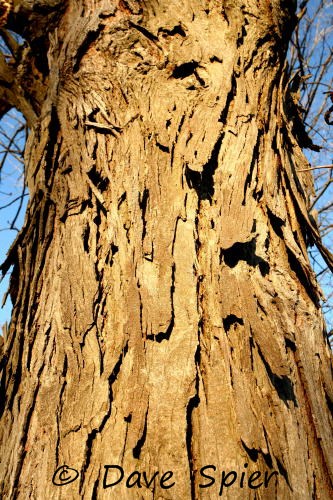
Shagbarks, aptly named for the long, peeling shreds of bark, can easily grow to a height of 60 to 90 feet. The record is 120 feet. The wood is strong and elastic and was once prized for tool handles, gunstocks, skis and chair backs. When burned, it gives off a lot of heat and makes high-grade charcoal.

Shagbark Hickory bark
In late summer and early fall, the thick-walled nut husks split into four sections and release the four-ridged nuts which are good to eat. (Squirrels, possums, Wild Turkeys and Wood Ducks would agree.) The nuts also can be ground in a meal-like flour or crushed and boiled to separate the oil. Rabbits and deer browse the twigs. In late winter, the trunks can be tapped in the manner of collecting maple sap.

child holding hickory nuts, some with the husk on (Bayberry Environmental Education Center, Junius, NY, when I was a naturalist there)

Hickories are related to walnuts and butternuts (Juglans spp.) which have numerous leaflets, all roughly the same size. All these trees are in the same family (Juglandaceae) along with pecans.


Corrections, comments and questions are always welcome at northeastnaturalist@yahoo.com or connect through my Facebook page and photo page. There's also a community-type page for The Northeast Naturalist. Other nature and geology topics can be found on the parallel blogs Adirondack Naturalist and Heading Out.

Sunday, April 28, 2013

Invasion

© Dave Spier

There's a wildflower that's trying to take over much of the country from Alaska to Georgia and all of the northeast to Quebec. (The USDA has a range map on their website.) It tolerates shade and crowds out native plants. Deer are repulsed by its garlic odor and flavor, making it a clever defense in hindsight. It's a prolific seed producer and if that's not enough, it releases chemicals that inhibit the growth of other nearby plants, particularly native tree seedlings. We're talking about Garlic Mustard (Alliaria petiolata, = A. officinalis and two other synonyms), a true member of the mustard family and relative of such familiars as cabbage, broccoli, cauliflower and of course, other mustards including the one used in the condiment.

Garlic mustard is a biennial. It takes two years to fully mature and go to seed. The first year, it produces only a few rounded to heart-shaped leaves as it concentrates on growing a root system. The second year, new and larger leaves (more triangular and coarsely toothed around the edges) emerge. A stem averaging one to two feet high sprouts a cluster of small, white flowers, each with four petals. These produce long, thin seed tubes that eventually dry, split and release two rows of numerous black seeds to start the process over again.

This invasive weed was brought here from Europe and Asia in the 1860's, probably to be used as a potherb. Various recipes can be found on the internet and involve using young leaves and flowerbuds and to a lesser extent flowers and seeds. This is another case of "eat it, if you can't beat it." From the looks of it, there are far more plants than we could possibly eat, so the next alternative is to pull them up by their roots, put them in a black plastic bag in the sun and eventually bury them in a long-term compost pile or otherwise dispose of the plants depending on the regulations in your neighborhood. Don't let them lay around. Even if you dry the roots and let the plant die, the seeds continue to mature. Mowing does nothing to stop the invasion because the roots quickly grow new stems and leaves and then flowers at a lower height. The seeds can lie dormant up to five years and then sprout, so the best alternative may be to trash the seed heads.

In its native Europe and eastward to India and western China, 68 insect species and seven types of fungi feed on the garlic mustard. None of these controls are present in this country. To make matters worse, deer eat our native wildflowers instead, making more room for the garlic mustard to flourish.


In Defense of Plants sent me information on a book called Garlic Mustard - from Pest to PestoIf you have any suggestions for controlling garlic mustard, or recipes to share, please send them along with any corrections, comments and questions to northeastnaturalist@yahoo.com or connect through my Facebook page and photo page

Thursday, August 9, 2012

Jewelweeds


Jewelweeds -- © Dave Spier

First off, they're not weeds.  They're attractive native wildflowers. Second, and this is unfortunate, they are not jewels.  The name comes from water's inability to wet the leaves, so after a rain or morning dew, beads of water rest on the surface and scatter light like diamonds.  The plant's alternate name, touch-me-not, refers to the small seed pods that spring open and eject the seeds if you touch them when plump and ripe.


There are two species based on color.The dangling, one-inch flowers [roughly the length and width] of the yellow version, also called Pale Touch-me-not (Impatiens pallida) have a tail-spur that points down.  It's mostly found in limestone regions with alkaline soils and prefers damp locations like wooded flood plains and shady ravines with a steady supply of moisture.


The orange species, a.k.a. Spotted Touch-me-not (Impatiens capensis) is spotted with reddish-brown and the longer spur curves under the tail.  It is normally common and widespread but given its preference for damp ground and ditches, it's struggling this year with the drought.  The ones in my woods have long withered and died.

Impatiens are succulents with translucent green stems.  Crushed leaves and stem juice (particularly from the Orange Jewelweed) are folk remedies for poison ivy rash, insect bites, nettles, minor burns and cuts.

Young shoots in spring and the stems and leaves in summer can be eaten as cooked greens.  Boil in two changes of water and discard the water.


Corrections, comments and questions are always welcome at northeastnaturalist@yahoo.com or connect through my Facebook page or my photo page.

Tuesday, November 8, 2011

November Trails -- Part 1


November Trails
© Dave Spier

Unexpectedly warm and sunny weather followed the first feeble attempt at an autumn snowfall. Call it Indian Summer, or just call it enjoyable. Mornings were chilly and dew-laden, but that's normal November. I hope you have a chance to get out and savor the weather before things go downhill again.

The trail through the field back to the woods is dotted with open milkweed pods releasing brown seeds to float on white down. The zebra-striped Monarch caterpillars that fed on the toxic white sap of the summer leaves long ago transformed to butterflies and headed south toward their winter home in Mexico. You might have noticed the Canadian Monarchs passing through New York in early October.

Near the milkweed, the once-plump, off-white berries on Red-panicled Dogwoods are now wrinkled and dry. Chickadees have been snatching as many of the fruits as they can, and the ones that fall to the ground become food for grouse. The shrub's name comes from the red stems that hold the berries, but the gray bark on the main branches gives it the alternate name, Gray Dogwood. [see the previous blog post] Next to the dogwood, a flock of Purple Finches landed in a small tree and then flew again in unison. These birds, red-raspberry relatives of goldfinches, breed across southern Canada and winter in the eastern half of the United States. We see them most often during their migrations.

In the middle of the field, a thorny rosebush is covered with tasteless rosehips that are nonetheless high in vitamin C. These small, red fruits are credited with supporting the expansion of the mockingbird from its southern strongholds to the cold climates of Upstate New York.


Northern Mockingbird in Multi-flora Rose bush -- © Dave Spier

In the woods, small beige moths flit among the trees while a pair of Red-bellied Woodpeckers chase each other from one tree trunk to the next. In spite of brilliant scarlet feathers on the nape (back of the neck) and crown of the male, the bird is named for an obscure patch of salmon red on the belly between the legs. The bird has to be at just the right angle to see it. The problem with the name is that another woodpecker with an entirely red head and neck took the name Red-headed Woodpecker. That species is a southern bird; we seldom see them in the Finger Lakes region.

Connect with me on Facebook.

Tuesday, May 3, 2011

Red Trilliums


© Dave Spier
 
Red Trilliums (Trillium erectum) are attractive woodland wildflowers native to Upstate New York, but admire them from a distance.  They have many nicknames, but “stinking Benjamin” and “wet-dog trillium” will clue you to their ill scent.  Both the liver-red color and bad smell are nature’s design to attract carrion flies to aid in pollination.
Trilliums grow with three broad, diamond-shaped leaves and three green, leaf-like sepals alternating with three colored petals.  This plant belongs to the lily family, hence the name tri-lillium, or three-part lily.  Other common names for this species include Purple Trillium, Wake-robin, Rule-of-three, and in Maine, Wild-piney.
Peterson’s Edible Wild Plants book indicates that young leaves can be added to salads or boiled and eaten like spinach, but it’s too late for this year.  After the flowers open, the leaves turn bitter.  Another source I consulted warns that “the leaves contain calcium oxalate crystals and crystal raphide, and should not be consumed by humans.”  Either way, this species is seldom abundant enough to be used as a food source, and removing the leaves will stress or possibly kill the plant.  It takes woodland wildflowers an average of seven years to reach maturity and begin flowering due to the lack of sunlight in the shade of tall trees.  New York State ranks the Red Trillium as “Exploitably Vulnerable.” 
Berries and roots are mildly poisonous, although you might see birds and wild mammals eating the red fruits later in the year (but remember, they also eat Poison Ivy berries).
A generalized range map can be found on the USDA website.

Corrections, comments and questions are always welcome at northeastnaturalist@yahoo.com or connect through my Facebook page and photo page. There's also a community-type page for The Northeast Naturalist. Other nature and geology topics can be found on the parallel blogs Adirondack Naturalist and Heading Out.

Saturday, May 22, 2010

Cattails


© Dave Spier

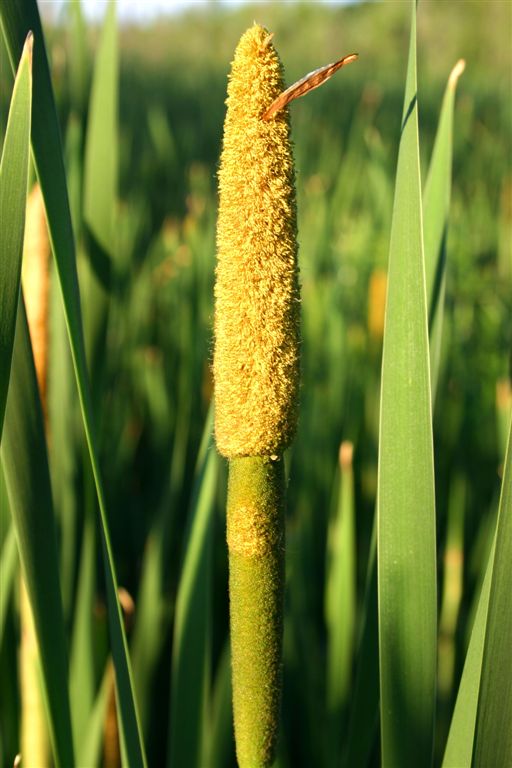
Supermarket, water purifier and wildlife habitat -- take your pick. The cattail is one of nature's most useful and versatile plants. My preference is its edibility. In early summer, the flower spikes produce bright yellow pollen that can be collected in a bag by shaking the heads. After sifting, the protein-rich pollen can be added to wheat flour to make a 50-50 mix. If you're going to store it, thoroughly dry it first. Pollen can also be mixed into pancake batter. Starting at the end of summer, look for horn-shaped sprouts growing on the ends of rootstocks. These can be tossed in a salad or boiled and buttered. They're available until the ground freezes. The starchy core can be used like a potato. During cold weather, the rootstocks become starch-filled as they store food for the long winter. To produce a white flour, wash, peel and then crush the core in cold water. Remove the fibers, allow the starch to settle, pour off the water and dry thoroughly. In early spring, young shoots can be peeled and used like asparagus. Immature flower spikes can be boiled and buttered like corn on the cob.

Because the roots are rich in starch, they were eaten by the Cossacks of Russia. The name carried to England where they are eaten as "Cossack asparagus." On the Pacific coast, cattails are called "Tule-reeds." Sometimes they are mislabeled bulrushes, but that term is properly reserved for a group of sedges which are distant relatives.

Not interested in eating cattails? Then how about water pollution removal? Man-made wetlands containing cattails and other aquatic plants are used to naturally purify sewage water. These systems work best in the South because of the climate, but smaller-scale operations contained in greenhouses work in New York. Some of the research was pioneered at Cornell many years ago. The advantages are low cost and high efficiency. By the time the water reaches the end of the artificial marsh, it's clear and full of macroinvertebrates (tiny animals with external shells). Tiny crustaceans called copepods are indicators of very clean water. Natural marshes continually clean water on a large scale from ice-out to ice-up. Bacteria on the plant roots aid in the process by consuming ammonia, nitrogen, and phosphorus and then breaking down industrial chemicals, detergents, and pesticides into simpler compounds that can be absorbed by the plants.

Many of those artificial outdoor water treatment systems become defacto wildlife refuges and even recreation areas because there are no objectionable odors. Birders are particularly interested in the ducks, swallows, redwings and herons that visit the marshes. But, if you're down South, just watch out for the alligator in the next pond...

It's important to preserve our remaining wetlands and create new ones to replace what's been lost. These low areas store runoff from storms, then filter the water to make it cleaner and recharge underground aquifers. On the surface, they are prime wildlife habitat. For example, muskrats are intricately tied to cattails for food and building materials. Many bird species are adapted to nesting in cattail marshes. Turtles and frogs add to the this wildlife variety. Snow Geese eat the underground stems and roots. Blue and yellow species of iris, purple Pickerelweed and white arrowhead flowers combine to create a garden effect. Red Cardinal Flower and its close relative, blue lobelia, plus pink Swamp Milkweed and yellow Marsh Marigold will grow around the edges. Beware of one problem plant: the invasive Phragmites, or tall reed, which is a dense, aggressive grass that crowds out cattails and reduces the value of wetlands as wildlife habitat.

At one time there were two distinct species of cattails, the Common or Broad-leaved Cattail (Typha latifolia) and the Narrow-leaved Cattail (Typha angustifolia), but now some cattails are hybrids of these two. This is particularly true in the Finger Lakes region where the dominant form, called the "blue cattail," has intermediate-width leaves.

What’s your opinion of cattail marshes? Contact me at northeastnaturalist@yahoo.com If you visit the Montezuma Audubon Center just north of Savannah, NY (in southeastern Wayne County), walk to the small education ponds south of the building, or hike to the western impoundments and investigate the plants and animals growing in the cattail marshes around the perimeters. If you're particularly interested in wetland birds, check out the Eaton Birding Society facebook group or the old website for the Montezuma Birding Trail.

Tuesday, June 3, 2008

Invasion

This article, with slight revisions, has been reposted at http://northeastnaturalist.blogspot.com/2013/04/invasion.html
(The original copyrighted article and photo were first published in the Times of Wayne County, May 19, 2008. All rights reserved.)