Showing posts with label wetlands. Show all posts

Thursday, August 1, 2013

European Frogbit

Frogbit

© Dave Spier

Among its many incursions into southeastern Wayne County, New York, European Frogbit (Hydrocharis morsus-ranae) can be found edging Black Creek as it leaves the Montezuma Marshes west of Savannah, just before passing under Route 31 and flowing on its way to Crusoe Creek. This Eurasian species was introduced into Ottawa, Canada in the 1930's and has since spread around the lower Great Lakes and St. Lawrence Seaway watersheds. Its spread northeastward has been limited only by water salinity. There is no limit to the south and west, so it has reached Vermont, New York and Michigan. Frogbit can form dense colonies on the surface and threatens biodiversity by crowding out native species and shading underwater plant growth needed by fish. Its rapid growth also can clog waterways and hinder recreational activities such as boating, canoeing and fishing.
 

Frogbit resembles a miniature waterlily, but its small, pistilate (female) flowers have only 3 petals around a yellow center, unlike the showy native waterlilies with their numerous petals in concentric rows. The frogbit flower resembles those of arrowhead plants, which is not too surprising because both are monocots in the Order Alismatales (although they are in different families). The plant could survive very well without flowers, because its seeds contribute very little to its spread. Instead, the plant can hitch-hike on boats, while its winter buds (called turions) sink to the bottom and lie dormant until spring, when they rise and travel with water currents. The buds grow into complete plants which then enlarge by sending out runners (called stolons) which sprout additional plants in an expanding network that can interlock with adjacent colonies.
 
Frogbit's round, floating leaves (generally two inches or less in diameter), are often notched like water-lilies and grow in rosettes (i.e., radiating from a center point). Dangling roots (to 12 inches long) seldom anchor in the bottom mud, allowing mobility on surface currents, even blowing upstream.

European Frogbit can be distinguished from its native counterpart (Limnobium spongia) by checking the leaf stems. American Frogbit has a midline groove.


Corrections, comments and questions are always welcome at northeastnaturalist@yahoo.com or connect through my Facebook page and photo page. There's also a community-type page for The Northeast Naturalist. Other nature and geology topics can be found on the parallel blogs Adirondack Naturalist and Heading Out.

Wednesday, June 12, 2013

Yellow Warblers


Many warblers have at least some yellow, but I imagine if there's one that deserves the name of the color, it's the Yellow Warbler (Setophaga petechia).

The spring migration has come and gone, and now we have to be content with the summer residents that remain. Robins seem to be everywhere, and unfortunately so are the starlings and grackles. High in the tree tops, you might hear an oriole; they seem to prefer big cottonwoods here. If you have orioles near you, what trees do they prefer?  Orioles can be relatively common, but seldom do we get a good look at the male's flashy orange and black.
 

male Yellow Warbler at the Allegany Nature Pilgrimage (southwestern New York,
always the first weekend after Memorial Day) during a bird-banding demonstration

Another colorful songster, though relatively common, is likely to be overlooked unless you’re in the habit of scanning shrubby wetlands and thickets while listening for its "sweet, sweet, sweeter than sweet" song. Check the tops of shrubs and dwarf willows for a bright but tiny spot of yellow. With binoculars, look for rusty-red streaking on the breast. This is the male Yellow Warbler, one of 51 North American species of wood warblers – many of which are now uncommon or quickly pass through on their way north. The Yellow Warbler on the other hand is relatively common and a widespread nester from coast to coast across the northern 2/3rds of the U.S., Alaska and most of Canada with breeding populations extending down through coastal California and central Mexico. (If you're submitting an eBird report, you can use the "Add Details" button, and then the "Breeding Code" button to record any breeding behavior you observe or hear.)
 

female Yellow Warbler at Montezuma National Wildlife Refuge, NY

Warblers are small birds, generally four to five inches long, with slender, straight-pointed bills used like tweezers to collect insects. Warblers are very active and it’s hard to get a good look at any of them. Most prefer woodlands in various stages of growth from scrub to mature forest and for this reason they are referred to as wood warblers. Within these habitats, some warblers stay in the treetops (giving birders "warbler neck"), some hide on the ground and the majority travel in-between. Yellow Warblers are somewhat unusual in preferring more open settings. Willow thickets and isolated shrubs in cattail marshes seem more to their liking, but any thicket will do in a pinch.

male Yellow Warbler checking its reflection for a rival in our camper window

The Yellow Warbler is a common summer resident that begins returning at the end of April. The remainder trickles in throughout May. Aptly named, they are yellow on the head and underneath, olive-yellow on the back, and a mix of olive and yellow on the wings. Males are brighter with reddish streaks on the breast. The more aggressive and dominant males have darker streaks. Females are duller with faint rusty streaks on the sides. If you get a close view, look for yellow tail spots that are usually missed.

Brown-headed Cowbird egg in Yellow Warbler nest (Bradford County, PA)

The Yellow Warbler is one of the species most frequently parasitized by cowbirds, but they have developed a defensive strategy against the blackbirds. After a cowbird egg is deposited, the Yellow Warbler builds a new nest on top of the old and lays a new batch of their own eggs. If the cowbird returns, the warbler repeats the process. The record is a six-story nest (although there is an unconfirmed report of a 10-story nest near Cayuga Lake, NY, in 1923).

As a species, the Yellow Warbler is perhaps the most widespread of the warblers, but there are three distinct groups with four subspecies. Together they span the continent and range from the Arctic down through Mexico and the Caribbean to the northern reaches of South America. You can find an interactive range map on eBird.
 
pair of Yellow Warblers at Montezuma National Wildlife Refuge, NY

On their territories, Yellow Warblers sing two types of songs with a number of individual variations. One song type is used to attract a mate, while the other is used to defend territories against other males. With wetlands being a limited resource, there is intense competition for prime nesting space. After mating, recognition of individuals becomes important, so minor variations in songs become important. You can find more information along with a static range map and recordings of Yellow Warbler songs on All About Birds.
 

Yellow Warblers have only one brood per year and as soon as the young are independent, the species begins its southward migration. They are one of the earliest summer nesters to leave. Some are gone by the end of July and (almost) all have left by the time goldenrod is in full bloom.

Corrections, comments and questions are always welcome at northeastnaturalist@yahoo.com or connect through my Facebook page and photo page. There's also a community-type page for The Northeast Naturalist. Other nature and geology topics can be found on the parallel blogs Adirondack Naturalist and Heading Out.

Thursday, December 13, 2012

Coots


© Dave Spier
 
"Mudhen," "chicken of the marsh," and "water guinea" are just a few of the many nicknames for a dark bird with a white bill commonly found on area waters. Birders know it as American Coot (Fulica americana), as in "crazy as a coot." The poor bird gets no respect.

In the winter, look for coots on bays, saltmarshes, lakes or canals wherever there is enough open water for them to get a long, running start to become airborne. This includes the Pacifc coast from British Columbia south to Panama, then east across the southern states and up the eastern seaboard to Cape Cod. An eBird bar chart for any county or location (which lists all of the bird species reported and their seasonal distribution, i.e. when to expect them) will show if and when the coot has been present. (If you're in the coot's normal winter range and there is a gap the 3rd week in December, I'll bet it's an oversight because birders are too busy Christmas shopping instead of scoping local waterways.) Make a note; if you see a coot the third week of December, let me know and I'll help you submit the observation to eBird!

Coots have dark-gray bodies and nearly-black heads which contrast sharply with white bills. The adult's eyes are bright red. The legs are green and their long toes have lobed edges to help them swim. They usually travel in flocks and sometimes you can find a raft of several hundred coots swimming together.

Although they may hang around with ducks, a coot's body structure is quite different. The bill is somewhat chicken-like and the feet lack webs between the toes. Coots are related to cranes (but much smaller) and to rails, as in "skinny as a rail," but plumper. (Rails are secretive marsh birds laterally compressed for slipping through cattails and reeds. By now, they've gone south for the winter.)

Coots are primarily vegetarians. They will dive for underwater plants or pluck at plants in a marsh. Another preferred feeding tactic is to steal plants from other coots or ducks. (More on All About Birds...)

Corrections, comments and questions are always welcome at
northeastnaturalist@yahoo.com or connect on my Facebook pages - Dave Spier (photographic naturalist) and my personal page. There is now a community page for The Northeast Naturalist.

Sunday, September 16, 2012

Bur-marigolds

Bur-marigolds at the Montezuma Audubon Center, Savannah, NY, in September

Check your local damp meadows and marsh edges for a golden haze of beautiful, yellow, native wildflowers called bur-marigolds (Bidens species). Resembling small sunflowers, the bright-yellow flowers have an average of eight rays around a central disk. Not surprisingly both the sunflower and bur-marigold are in the Aster (or Composite) family.

Two species may occur in New York. The Showy, or Larger, Bur-marigold (B. laevis) has rays longer than a half inch and flower heads up to two inches in diameter. This species is found mainly from California across the lower (southern) states, and locally into the Midwest and also New York along the Lake Ontario plain. Apparently it's also widespread along the East Coast to Massachusetts.  A second species, Nodding Bur-marigold (Bidens cernua) has smaller yellow flowers that nod as they ripen.  It is widespread across Canada and the continental states except the Southeast and it's the more-likely species in New York, especially the Finger Lakes Region. Both species have opposite leaves that are narrow, long-pointed and toothed along the margins. The leaves of B. cernua are sessile (stalkless) and hug the often-rough stems.  B. laevis is smooth-stemmed with leaves that narrow (taper) at the base. The Finger Lakes Native Plant Society has an excellent species profile on their website.

Bur-marigolds also are known as beggar-ticks and stick-tights, referring to the sharply three-pronged seeds [achenes] that stick to clothes as you brush by a ripe plant.  The numerous seeds are eaten by upland and aquatic birds.

Additional reference:
Newcomb's Wildflower Guide, by Lawrence Newcomb and Gordon Morrison (© 1977), published by Little, Brown & Co.

Corrections, comments and questions are always welcome at northeastnaturalist@yahoo.com or you can connect through my Facebook page at Dave Spier (photographic naturalist) or my personal page, Dave Spier with the profile photo of me birding through a spotting scope. There's a new Fb page for The Northeast Naturalist.

Thursday, September 13, 2012

Flowering Rush


At first glance, the individual flowers resemble lilies, and that wouldn't be too far off. Lilies and Flowering Rush (Butomus umbellatus) are both monocots, meaning that their seeds sprout with one initial "seed-leaf" and not two like dicots. The flower heads of Flowering Rush resemble those of chives and onions which makes perfect sense because onions are really lilies. The clusters are in arrangements called umbels (think "umbrella"); all of the flower stems radiate fom a single point at the top of the main, cylindrical stalk. Queen Anne's Lace (Wild Carrot) flowers also grow in umbels, but that plant is a dicot with deeply-dissected, feather-veined leaves.

The leaves of Flowering Rush are narrow, long-pointed and sword-like with parallel leaf veins, again similar to chives and other dicots, but it's somewhat misleading because Flowering Rush is in a plant family of its own. (In fact it's the only genus and species in that family.) It's capable of growing to a height of five feet, under the right conditions, with leaves up to 40 inches long. Most of the time it grows more in the one to four-foot height range.


Flowering Rush is an alien growing on muddy shores along the St. Lawrence Seaway and it has spread to Lake Champlain and the Great Lakes and beyond. It's a Eurasian species brought here as an ornamental in the early 1900's, and it continues to spread from Vermont to Washington and adjacent Canada.

The flowers are rather attractive with three pink and white petals alternating with three smaller pink sepals. In the center are nine pink-and-white male stamens in a radial pattern around six magenta female pistils.

Like all invasive species, it competes with desirable native wetland species, and once started, Flowering Rush is hard to irradicate because the trailing rhizomes spread under the mud and pea-sized bulbils detach, disperse in the water and quickly germinate into new plants. Varieties of this plant growing in the east also produce seeds that can spread on water currents.

There are many desirable native substitutes for Flowering Rush, including Sweet-flag, Northern Blue-flag, Pickerelweed, Giant Bur-reed, Lake Sedge, and Hardstem Bulrush. Blue-flag and Pickerelweed are attractive personal favorites.


Corrections, comments and questions are always welcome at northeastnaturalist@yahoo.com or you can connect through my Facebook page at Dave Spier (photographic naturalist) or my personal page, Dave Spier with the profile photo of me birding through a spotting scope. There's a new Fb page for The Northeast Naturalist.

Wednesday, September 12, 2012

Marsh Wrens


As a group, wrens are small, noisy, brown birds that often hold their short tails upright.  Their bills are thin and curve down to a point for picking and eating insects and spiders.  The House Wren is the most familiar; it is plain brown and nests in tree cavities or nest boxes, often in proximity to human dwellings.

Its cousin, the Marsh Wren (Cistothorus palustris) lives – where else – in cattail marshes.  Its gurgling, rattling trill can be heard any time of day or night.  (If you think you might have heard this wren, you can listen to a recording of its song on the All About Birds website.)  On rare occasions when it perches on a cattail top in the open, you’ll notice a dark cap and light line above the eye.

During breeding season, nests are lashed to vegetation and sometimes hidden in shrubs.  Construction includes a woven dome of grasses and sedges with the entrance on side.

The Marsh Wren population is declining in the east, but increasing in the west.  Major differences in the two subspecies’ songs may indicate two separate species.  The combined winter range extends along the Gulf coast into the Southwest and down through all of Mexico.  A year-round population hugs the east coast from the Mason-Dixon line [the Pennsylvania/Maryland border] south to Florida. During migration, a Marsh Wren can stop in any of the lower 48 states.

The Marsh Wren photo was taken September 3rd from the dike separating the two main impoundments at the Montezuma Audubon Center north of Savannah, New York, where they can be heard, and sometimes seen, throughout the late spring, summer and early fall. You can get an idea of their seasonal distribution (and all the other species) in the Wetlands Complex by looking at the eBird bar chart for Wayne and Seneca Counties, New York.

On Saturday, September 29, there will be an organized canoe trip in the Montezuma Wetlands Complex from 2 pm – 4:30 pm.  Join the Montezuma Audubon Center’s Teacher-Naturalist, Frank Morehouse to explore the Seneca River along Howland’s Island, New York.   Learn about the birds and other wildlife of the area on a leisurely paddle.   There is a fee; canoes, paddles and life jackets will be provided (and binoculars if needed).   Bring water and snacks.   Pre-registration is required by calling (315) 365-3588 or email montezuma@audubon.org for details. The MAC website is http://ny.audubon.org/montezuma

Canoeing the Seneca River around Howland's Island, New York (file photo taken July 9th)  - © Dave Spier

Corrections, comments, questions and suggestions are always welcome at northeastnaturalist@yahoo.com  and on Facebook and The Northeast Naturalist.

Saturday, September 8, 2012

M.A.R.S.H.


M.A.R.S.H. --© Dave Spier

MARSH stands for the Montezuma Alliance for the Restoration of Species and Habitats, a group of volunteers that does everything from removing invasive species to planting new trees.  The next events, scheduled for September 12th, 15th and 22nd from 9 am to 1 pm, will be devoted to collecting ripe seeds from a variety of wetland plants including Arrowhead (a.k.a. "duck potato"), Pickerelweed and Bur-reed.  These species, along with bulrushes and cattails, create a habitat called an emergent marsh.

The seeds will be collected at the Seneca Meadows Wetland Preserve on Black Brook Road, which runs south from Rt. 318 (east of the four corners at Magee) and ends in Seneca Falls, New York. After drying, the seeds will be used to restore habitats on the Northern Montezuma Wildlife Management Area in the Town of Savannah, Wayne County, NY.  The MARSH volunteers are sponsored by the Friends of the Montezuma Wetlands Complex. To sign up, click their website link. BTW, lunch is provided.

The Seneca Meadows website includes a drop-down menu with a description of the trails and a PDF map link.  The I Love the Finger Lakes website has an excellent profile of both the wetlands preserve and the education center.

Corrections, comments and questions are always welcome at northeastnaturalist@yahoo.com or connect through my Facebook nature page and photo page. Other nature and geology topics can be found on the parallel blogs Adirondack Naturalist and Heading Out.

Thursday, September 6, 2012

Least "Mudpiper"

Least Sandpiper (Calidris minutilla) at Montezuma N.W.R., NY on May 13 - © Dave Spier (#D045935)

What's in a name? Take the compound word "sandpiper." Sand refers to the beach where these shorebirds are often found. The Lake Ontario shoreline of New York quickly comes to mind. Piper refers to the sound made by some species, although it's more of a peep. There's a group of small sandpipers, all similar in appearance, collectively nicknamed "peeps," in reference to their voices. Among these, the smallest is the Least Sandpiper, Calidris minutilla. Not only is it the smallest to pass through New York, it is the smallest shorebird in the world.

Least Sandpipers begin showing up in New York's Finger Lakes Region in April, peak through May, then decline in June and early July as the last of the birds fly to the Canadian tundra to nest and breed. Early migrants that failed to nest begin returning in early July and this reverse flow continues to build through the summer, peaks in September and trails off to end abruptly before November. The eBird bar chart for Wayne and Seneca Counties (NY) will illustrate this - but you can create a chart for any state or county you choose.


Least Sandpiper (Calidris minutilla) at Montezuma N.W.R., NY on May 18 - © Dave Spier (#D029504)

Most of our eastern birds seem to winter along the Atlantic coast from North Carolina to Florida, or across the Gulf coast south into Mexico and northern South America.  You can see the entire eBird range map for Least Sandpipers (or any species) on the Explore Data page.

Dark feathers with buffy or rusty edges give sandpipers a scaly appearance on the back and wings. The belly is usually white while the head, neck and chest are various shades of brown. The black bill, used to probe for food, is longer and thinner than the bills of songbirds. Most small sandpipers have black legs, but here is the one distinguishing feature of least's; their legs are yellowish or greenish-yellow.


Least "mudpiper" at Montezuma N.W.R., NY on May 18 - © Dave Spier (#D029488)

The length of a shorebird's bill determines its feeding style and diet. A very short bill, like that of a Semipalmated Plover, limits it to feeding on the surface. At the other extreme, very long bills like those of snipe, dowitchers and curlews, allow them to probe deeply into mud. Inbetween are most of the sandpipers which probe to a shallow depth and capture aquatic invertebrates like insects, small crustaceans, worms, and mollusks such as small clams and mussels. The Least Sandpiper prefers to feed on mudflats giving it the nickname "mud peep." Does that mean we should change its name to the least mudpiper?

Corrections, comments and questions are always welcome at northeastnaturalist@yahoo.com or connect through my Facebook page or photo page or Linked-in. Other nature and geology topics can be found on the parallel blogs Adirondack Naturalist and Heading Out.  For more information on the Finger Lakes region, visit ILovetheFingerLakes.com

The photo below is a migrating Least Sandpiper on the Lake Onatrio shore at Charlotte Beach (a.k.a. Ontario Beach Park), Rochester, NY on September 18 - © Dave Spier (#1148-13 scanned from a slide)

Wednesday, August 1, 2012

Cardinal-flower

Ruby-throated Hummingbird at Cardinal-flower,
Montezuma Audubon Center, Savannah, NY

Cardinal-flower -- © Dave Spier

This native perennial grows wild along streambanks and in swamps and other wet places up and down the eastern half of the U.S., northeast into Canada and south to Columbia. Look for it at the Montezuma Audubon Center (Rt. 89 N, Savannah, NY) where it grows along Crusoe Creek and also around the building where it has been planted to attract hummingbirds. The plant can reach two or three feet in height, making it a nice addition to any garden.

The Cardinal-flower (Lobelia cardinalis) gets its name from the bright-red blossoms hugging the upper stem. (Although sometimes called a spike, it is technically a raceme because of short flower stalks called pedicels.) Look closely at an individual corolla [flower] and you’ll notice three wide lobes forming a lower lip while two narrow lobes extend to the sides like arms. The male and female parts, also scarlet colored, form a narrow tube emerging like a crane above the petals. It looks custom-made to work with hummingbirds!


There was a hummingbird at these Cardinal-flowers when Donna and I first stopped on the boardwalk at Tinker Nature Park (Hansen Nature Center) in Henrietta, NY.


Cardinal-flower leaves are lance-shaped, long-pointed and serrated or toothed on the edges and they alternate on a single, main stalk. The plant contains alkaloids and should be considered toxic, as are other members of the genus Lobelia. In spite of this, Native Americans used root and leaf teas for various ailments. Cardinal-flower and its relative, the blue-violet Great Lobelia (another moist-ground species growing at the MAC) belong to the Lobelia subfamily of the Bluebell family.

Corrections, comments and questions are always welcome at northeastnaturalist@yahoo.com  Now you can connect through my Facebook photo page at Dave Spier (photographic naturalist) or my personal page, Dave Spier, northeast naturalist

Wednesday, July 11, 2012

Black Terns


Black Terns -- © Dave Spier

The cattails grew denser and denser. Long poles would have been more effective than paddles as we grabbed clumps of emergent leaves and pulled our canoe deeper into the marsh. We passed an opening at the targeted GPS coordinates, but there was no sign of a nest. "Okay, turn the canoe around," Frank said. Easier said than done. Should have worn chest waders and just gotten out of the canoe. It was more effective to back out.

To shorten the story, we did relocate the "nest." Talk about well camouflaged. Three hard-to-see eggs on a tiny mat of cattail leaves... Another declining bird species has turned up in the Northern Montezuma Wetlands outside of the federal refuge in Seneca County, and we were part of an ongoing state survey. 

Black Tern nest on Howland's Island, part of the Northern Montezuma WMA, Savannah, NY, on July 1.

Black Terns (Chlidonias niger) specialize exclusively in inland freshwater marshes. Most tern species are at least partially coastal and nest in salt marshes. Black Terns utilize cattail marsh openings created by feeding Muskrats and often build their nests on a floating Muskrat feeding platform, usually not much more than a mat of cut leaves an inch or two above the water. This nesting behavior makes them vulnerable to two things: invasive Purple Loosestrife and motor boat wakes. The loosestrife crowds out the cattails forcing the Muskrats to move elsewhere, whereas boat wakes can destroy the nest. Motorized boating is not permitted in the Northern Montezuma Wildlife Management Area and the loosestrife appears to be under control, at least for the moment. The presence of another aquatic plant, bur-reed, is a good indicator of Black Tern nesting potential. Since Black Tern eggs and chicks are preyed upon by Great Blue Herons, choosing a nest site in deeper water (preferably two feet deep) with a thick growth of yellow bladderwort will discourage the long-legged wading birds.

Terns are related to gulls, but have pointed bills for catching small fish. Terns also have forked tails and long, narrow wings. They fly gracefully and hover with bills pointed down when searching for prey. In addition to a few small fish, frogs and crustaceans, Black Terns eat a lot of spiders and insects (such as mayflies, water scorpions, and unfortunately, dragonflies).

Adult Black Terns in breeding plumage are unmistakable. The head and body are charcoal with white undertail coverts and they are uniformly gray across the wings, back and tail. The underwing linings are lighter. Young birds and winter adults have white underneath and white on the forehead and sides of the neck.

Black Terns breed from the lake plains of New York and the upper St. Lawrence Valley westward through the Great Lakes Region, across the upper Great Plains and into the Rockies and Cascades. They winter along the northern coasts of South America and during migration, they can show up anywhere in between. There is also a Eurasian subspecies. For a range map, go to eBird [or look in eBird under "Explore Data," then "Range and Point Maps"]. There is also a generalized map on All About Birds.

Agitated parent as we relocated the floating nest.

Corrections, questions, and comments are always welcome at northeastnaturalist@yahoo.com

________________________

July is a slow month for eBird reports. There's a huge swath of counties from the upper great Plains down and across to the Southeast with zero checklists [red on the map] for the month. As eBird approaches its 100 millionth record, they're having a contest [complete checklists only] and it would help greatly to fill in some of the gaps at the same time!

Thursday, July 5, 2012

Eastern Pondhawks

female Eastern Pondhawk with eggs emerging below the tail
all photos © Dave Spier

Eastern Pondhawks -- © Dave Spier

One of the more common July dragonflies in the eastern U.S. is the Eastern, or Common, Pondhawk (Erythemis simplicicollis). It likes to hang around ponds with vegetation (such as lily pads and cattails), slow streams and even lakes, or sometimes nearby in fields, roadsides or sunny, open spots. Low plants give them a hunting vantage for their voracious appetites. Dragonflies generally eat smaller insects such as mosquitoes (YES!), but in turn can become prey for birds including Purple Martins and bluebirds.

Female pondhawks are an attractive bright green with three dark, somewhat-rectangular spots down the top of the abdomen (S4-S6) and a mostly-dark tail with white tips (cerci). Juvenile males are nearly identical, then mature into entirely pruinose-blue bodies while maintaining the green face and white cerci.

adult male Eastern Pondhawk -- © Dave Spier

Males defend small territories over shallow water where the females lay their eggs while hovering just above the water. In the opening photo above (taken several years ago at the Montezuma Audubon Center when I was helping with the NYS Odonate survey), you might notice the eggs emerging from under the tail. She will repeatedly dip the tip in the water just enough to release the eggs. After hatching, young dragonflies (called naiads) spend several years growing and hunting on the pond bottom before emerging and transforming into winged adults.


Corrections, comments and questions are always welcome at northeastnaturalist@yahoo.com   Now you also can connect with me on Facebook. There are several Dave Spier's, so look for the Gaillardia flower at the top of my time-line, or see more of my photos on a new page, Dave Spier (photographic naturalist).


adult male Eastern Pondhawk -- © Dave Spier

adult female Eastern Pondhawk -- © Dave Spier

Facebook photo page: http://www.facebook.com/northeastnaturalist#!/pages/Dave-Spier-photographic-naturalist/457719854240996

Monday, July 2, 2012

Cerulean Warblers


Cerulean Warblers © Dave Spier


The Cerulean is an uncommon and vulnerable* warbler that is declining throughout its range in the Midwest and mid-Atlantic region. You can find a range map on eBird, and by zooming in far enough, you can locate actual checklists reporting this species.

The Cerulean's core summer range is soft-coal country – eastern Tennessee and Kentucky, southern West Virginia and Ohio and southwestern Pennsylvania – an area noted for strip mining and mountain-top removal which impacts the mature forests they need for breeding. This species is being considered for listing under the Endangered Species Act, and the National Audubon Society has already added the bird to its Watchlist.  

The Cerulean is named for the male's sky-blue color which is set off by white on the throat, belly and wingbars. Black streaks on the flanks, a black "necklace" and black in the wings and tail add contrast. The female is much duller and lacks the distinctive blue. Pale yellow replaces much of the white. Their preferred habitat is deciduous forests with tall trees and open understory like those found in wet bottomlands. Actually seeing the bird is difficult because it feeds and nests in the treetops, higher than most warbler species. You’re more likely to find the bird by its song, a rapid series of buzzy notes leading to a higher trilled note at the end. To listen to a recording, go to All About Birds.

The nest is an open cup made from fibers, grass and hair held together with spider silk. If the first nesting fails, the spider silk is reused in making a new nest. When the female leaves the nest after incubating for a time, she briefly drops like a stone before opening her wings to reduce the chances of attracting attention to the nest. The average clutch of four speckled eggs hatches in less than two weeks.

After breeding season, the Cerulean makes the long trek south through the southern states, flies across the Gulf of Mexico, migrates along the Central American highlands and ends up in its winter home in the evergreen forests of the northern Andes. Over 60% of this winter habitat has been converted from forest to farms and pastures, further impacting the species and adding to its decline. Ceruleans will use shade-grown coffee plantations, so in the interest of bird conservation, please consider buying one of the shade-grown coffee brands. Better yet, choose organic shade-grown if you have a choice.

[*conservation status from IUCN Red List of Threatened Species, code VU]
- - -
I've known about the Cerulean Warblers (Dendroica cerulea) at the Montezuma National Wildlife Refuge (between Rochester and Syracuse, NY) for some time, but they also live nearby along the Clyde River and Erie Canal in southeastern Wayne County (the Towns of Galen and Savannah). I had stopped to see Dave Odell, retired NYSDEC Region 8 Wildlife Manager, at his Old Duck Inn, a bed & breakfast southeast of Clyde in the Montezuma Wetlands Complex. I wanted to see what birds I might add to a checklist I started for the Montezuma Birding Trail, so I was happy to learn that Dave has been hearing the warblers. His 100-acre farm on Tyre Road extends downhill to the Old Clyde River. The wooded shoreline provides good habitat for this species.

Corrections, comments and questions are always welcome at
northeastnaturalist@yahoo.com For information on the next Montezuma Birding Tour, organized by the Montezuma Audubon Center in Savannah, e-mail montezuma@audubon.org

eBird range map:
http://ebird.org/ebird/map/cerwar?neg=true&env.minX=&env.minY=&env.maxX=&env.maxY=&zh=false&gp=false&mr=1-12&bmo=1&emo=12&yr=1900-2012&byr=1900&eyr=2012

All About Birds voice:
http://www.allaboutbirds.org/guide/cerulean_warbler/sounds

Thursday, June 7, 2012

Green Herons

Green Heron in the old Erie Canal southeast of Clyde, NY.

Green Herons -- © Dave Spier

For a time, the Green Heron (Butorides virescens) was known as the Little Green Heron, in reference to its relative size, but the joke became “it’s called that because there is so little green on it.”  Green-backed Heron was another name it once held, and that is a little closer to its appearance, but just slightly.  In bright sunlight, the back is dark grayish-green.  Adults are gray underneath with dark rufous (red) necks, streaked throats and dark crowns.  Young birds are more streaked on the neck and throat.  As the birds age, the legs vary from yellow-green to yellow and then finally orange on adults during breeding season.

At 18 inches long, it is small for a heron, but large compared to most birds we see regularly.  It is the length of a crow, but the heron’s wings are much shorter.  Seen flying overhead, on its way to the next swamp or back to its nest, the heron might be mistaken for a crow, but there are subtle differences.  The heron often travels alone in a straight line, deliberately heading for its next destination.  Crows are likely to travel in noisy flocks that swoop and turn as they decide where to go.  I’ve seen only crows harassing and chasing raptors.

Green Heron in the Old Erie Canal at Lock Berlin County Park off Route 31, between Lyons and Clyde.

Being shorter legged than other wading birds, the Green Heron prefers to hunt by walking down a fallen log that dips into the water at the end.  There it crouches and waits for a small fish or sometimes a frog.  The Green Heron is one of a growing list of animals observed using tools (inanimate objects that make a job easier or more efficient).  In the case of the heron, it uses food pellets, cereal, feathers or short sticks dropped on the water to lure fish close enough to catch.  The heron also might be found perched on the branch of a tree overhanging the edge of a stream or pond.  If it sees you first, it retracts its neck until the head seems to touch the shoulders.  Looking like a burl on the limb, the smaller posture helps it hide.  As a last resort, the heron leaps into the air with a loud “kee-ow” or “skow” and flies away.

Most herons nest in colonies, but not the Green.  Each pair nests by itself, sometimes far from water.  One spring, I watched two adults raise their family in the top of a tall spruce plantation about a mile from the river where they went to hunt for food.  I haven’t been back, but assuming they returned to nest again, life probably got easier for them when a pond was built nearby.

Green Heron flying over the Montezuma Audubon Center 
just north of Savannah, NY (in southeastern Wayne County). 
all photos © Dave Spier
Here's the hyperlink mentioned in the first comment:
Corrections, questions and suggestions are always welcome at northeastnaturalist@yahoo.com  For more information on wetland birds in the Montezuma Wetlands Complex and northern  Finger Lakes Region, please visit the Montezuma Birding Trail website http://montezumabirding.webs.com and look on the Montezuma birds page.  For information on the Eaton Birding Club that covers Wayne, Seneca, Ontario and Yates Counties, please visit http://eatonbirds.webs.com 

Wednesday, June 6, 2012

Spotted Salamanders


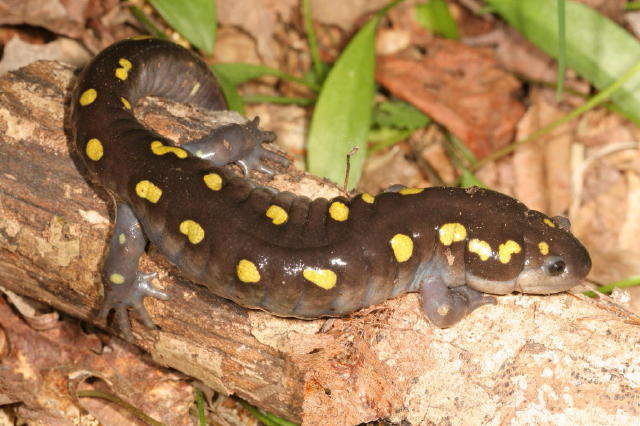
Spotted Salamanders -- © Dave Spier


I was working around the vegetable garden (no surprise there), trying to fix the fence when I lifted one of the old boards that helps suppress the weeds. Resting in one of the small-animal (vole?) runways was a Spotted Salamander, and this was a totally unexpected surprise. It's possible the salamander made these tunnels, but looking at its soft, clawless toes, I wonder how.

This species is famous for its mass migrations on the first spring night with a warm rain, usually in late March, but I always miss that event. The salamanders, like other amphibians, are heading for the nearest woodland pond or vernal pool (essentially a temporary puddle in the woods) to lay their eggs before returning to their damp, daytime hiding spots. Vernal pools lack fish - an important consideration in the survival of larval amphibians. The downside is a race against the pool drying out before the transformation of the larvae to a terrestial form.

The only time I've actually seen Spotted Salamanders in the past was uncovering them in the woods with the help of an expert leader at the Allegany Nature Pilgrimage (always the first weekend after Memorial Day when the holiday crowds are gone). That's where these photos were taken.

The Spotted Salamander (Ambystoma maculatum) has a wide range from the lower Mississippi Valley to the Canadain Maritimes. Along with ten other eastern species in the genus Ambystoma, this family of amphibians is referred to as the Mole Salamanders because they stay underground most of their lives.

The Spotted is typically around seven inches long with a heavier build than most salamanders. (The record length is almost 10 inches.) Two rows of yellow spots run down the sides of its dark-brown body from head to tail. It has four toes on each front "arm" and five on each leg in back.

At night, it hunts for a variety of invertebrates including slugs and its favorite food, earthworms. Both of these diet items are in abaundance around our garden. Normally Spotted Salamanders live in moist forests where rotting logs, dead bark and leaf litter provide the right habitat for finding food and hiding. Shade from the tree canopy keeps the ground cooler and reduces drying. What's unusual is that our garden is in the open on top of a hill, quite a walk from the swamp forest at the bottom of the drumlin. Oh well, I guess the salamander knows what it's doing.

Corrections, comments and questions are always welcome at
northeastnaturalist@yahoo.com

Sunday, June 3, 2012

Blue Flag


Blue Flag -- © Dave Spier


The Larger Blue Flag, Iris versicolor, or Fleur-de-lis, is the native alternative to the invasive Yellow Iris. These beautiful perennial herbs are cross-fertilized by honeybees, bumblebees and the Syrphid flies that are often mistaken for bees. In return, the iris provides sustenance in the form of nectar for these insects.

The pollen-producing stamens are hidden inside the iris at the base of the three "falls," the drooping, bluish petals with violet veins curving to the yellow runways that lead to the interior. To get inside, the insects crawl under the arching female styles where pollen is dislodged.

Syrphid fly visiting Larger Blue Flag at
Seneca Meadows Wetland Preserve - © Dave Spier

Several small, long-tongued butterflies have "learned" to bypass the pollen trap and go directly to the nectar between the divisions, thus depriving the iris of cross-pollination.

To learn more about native plants and their role in the environment, visit Habitat Gardening in Central New York, a chapter of Wild Ones: Native Plants, Natural Landscapes, or contact me at northeastnaturalist@yahoo.com Also visit the parallel blog http://adirondacknaturalist.blogspot.com/ for a profile of another wetland species, the Cinnamon Fern.


Wednesday, May 23, 2012

Yellow Iris

Yellow Iris at Allegany State Park in NY (Red House Lake in the background) during the Allegany Nature Pilgrimage -- © Dave Spier


Yellow Iris -- © Dave Spier


Another beautiful alien, this one escaped from water gardens...

Yellow Iris, also called "water flag," grows in the shallow edges of wetlands and ponds where the depth is generally less than 10 inches. It has spread across the United States and you can find a distribution map on the USGS website. Since I live in the Finger Lakes region of New York and travel Route 31, I mostly notice it along sections of the old Erie Canal on my way to the Montezuma Audubon Center.

The scientific name, Iris pseudacorus, comes from Iris, the Greek goddess of the rainbow (referring to the many colors in this family of plants) plus a contraction of the Greek words for "false sweetflag," referring to the similar, sword-like leaves, although sweetflag is actually an arum related to Jack-in-the-pulpit and Skunk-cabbage. Both the iris and the Sweetflag have long-pointed leaves with a prominent mid-rib.

The showy, yellow blossoms - up to four inches across - have three falling sepals surrounding three erect petals. The flowers are held above the leaves by stalks reaching a height of three to four feet. This made the species attractive to horticulturists who brought the plant to the United States in the early 1900's from its native European and North African habitats.

In suitable climates (generally the Southern Sates) it can be used to treat sewage and remove metals from wastewater. Given time this long-lived perennial can form dense, single-plant (monotypic) stands to the detriment of our native wetland plant species. It spreads by using underground rhizomes as well as seeds. Even though associated with wetlands, it can survive a drought up to three months and the seeds can survive a fast wildfire.

Be careful when handling this plant; it's poisonous and can cause skin irritation.

Yellow Iris and leaves at Allegany State Park in NY during the Allegany Nature Pilgrimage -- © Dave Spier

Corrections, comments and questions are always welcome at
northeastnaturalist@yahoo.com