Tuesday, June 19, 2012

Bee-balm


Bee-balm -- © Dave Spier

I’ve discovered a "new" bird species – the yellow-crowned hummingbird. Okay, before the birding community gets too excited, it was just a ruby-throat with pollen on top of its head. While visiting our Bee-balm flowers, the bird’s head was brushing against the stamens and being dusted with yellow grains of pollen. Unwittingly, the hummer would carry this to the next flower where some would reach the pistil (female part of the flower), thus assuring cross-pollination. Isn’t nature clever? By the time I got my camera, the pollen had rubbed or blown off.

Bee-balm (Monarda didyma), also called Oswego Tea, is a bright-scarlet member of the mint family. Related to bergamots, the showy flowers grow in dense whorls at the top of a square stem with opposite pairs of pointed leaves. The leafy bracts under the flower head are also reddish. This native plant grows wild on rich, moist soil, often along wooded stream banks, but it has been tamed for garden use. It’s a favorite nectar source for hummingbirds.

You can make an aromatic tea by steeping fresh or dried leaves and flowers for 10 minutes, or you can mix it with other teas. Enjoy…

If you live or travel in the vicinity of Savannah, NY (southeastern Wayne County), stop at the Montezuma Audubon Center (on the west side of Route 89 about 1.7 miles north of the village) and see how the hummingbird/butterfly garden is doing. The Bee-balm is on the east end of the garden. There’s usually a hummingbird feeder hanging on the wooden fence that hides the propane tank behind the garden. From one of the picnic tables, you can watch both the garden and all of the feeders on the north side of the building.

Do you plant any native flowers for hummingbirds or butterflies? To find out what else we can do to help wildlife, visit Wild Ones or contact me at northeastnaturalist@yahoo.com If you're in central New York, there's a chapter at http://www.hgcny.org/

Photo notes: Canon 300mm/f4 on 8-mp XT body; exposure = 1/500 sec., f/5.6, ISO 400. Our Bee-balm just started blossoming this year, so I pulled a file photo taken July 5 at 3:44 pm in the afternoon when our garden is still in full sunlight.  Original cropped to 1923 x 1354, then resized for the blog.

Wednesday, June 13, 2012

White Admiral


White Admiral -- © Dave Spier

Sounds like a naval officer in dress uniform...

From outward appearances alone, it would be hard to guess that the White Admiral butterfly, Limenitis (= Basilarchia) arthemis arthemis, is closely related to the Viceroy (Limenitis archippus), the Monarch imitator (or mimic). The former is nearly black with a prominent pair of arced white stripes on the wings. The latter is orange with black edges and veins. What they do share are reduced front legs with hairs, hence the family name, Brush-footed Butterflies (Nymphalidae), the largest family of true butterflies. Many members are familiar, partly due to medium or large size, and frequently visit flowers. (See my Red Admiral blog.) Butterflies themselves are sometimes nicknamed "flying flowers."

The White Admiral can be regarded as a northern species. It ranges from Canadian forests south into central New England, then down through the mountains to Pennsylvania and westward to Minnesota. Its southern counterpart is the Red-spotted Purple, essentially the same butterfly without white stripes (probably an evolved trait to avoid predators). For this reason, the White Admiral is sometimes called the Banded Purple. Where the two subspecies overlap from southern Maine to Michigan and Iowa, they freely interbreed.

This White Admiral was on my driveway, not its typical habitat.  All photos © Dave Spier

The White Admiral's preferred habitat is open forests and woodland edges where its larvae feed on Black and Yellow Birch (both of which have a wintergreen flavor, if that matters), plus willows and aspens (both in the willow family), and to a lesser extent hawthorns and maybe shadbushes (with these last two in the rose family). Adults drink nectar, running sap and aphid honeydew or feed on fruit, carrion and dung.

I use my Canon 300mm/f4 like a long macro lens when photographing large insects. [body: Canon XT, exp.: 1/500, 5.6, ISO 400] Personal style preferences include "cloudy" as my default white balance, but it easily can be changed because I shoot RAW.

Corrections, comments and questions are always welcome at northeastnaturalist@yahoo.com

Thursday, June 7, 2012

Green Herons

Green Heron in the old Erie Canal southeast of Clyde, NY.

Green Herons -- © Dave Spier

For a time, the Green Heron (Butorides virescens) was known as the Little Green Heron, in reference to its relative size, but the joke became “it’s called that because there is so little green on it.”  Green-backed Heron was another name it once held, and that is a little closer to its appearance, but just slightly.  In bright sunlight, the back is dark grayish-green.  Adults are gray underneath with dark rufous (red) necks, streaked throats and dark crowns.  Young birds are more streaked on the neck and throat.  As the birds age, the legs vary from yellow-green to yellow and then finally orange on adults during breeding season.

At 18 inches long, it is small for a heron, but large compared to most birds we see regularly.  It is the length of a crow, but the heron’s wings are much shorter.  Seen flying overhead, on its way to the next swamp or back to its nest, the heron might be mistaken for a crow, but there are subtle differences.  The heron often travels alone in a straight line, deliberately heading for its next destination.  Crows are likely to travel in noisy flocks that swoop and turn as they decide where to go.  I’ve seen only crows harassing and chasing raptors.

Green Heron in the Old Erie Canal at Lock Berlin County Park off Route 31, between Lyons and Clyde.

Being shorter legged than other wading birds, the Green Heron prefers to hunt by walking down a fallen log that dips into the water at the end.  There it crouches and waits for a small fish or sometimes a frog.  The Green Heron is one of a growing list of animals observed using tools (inanimate objects that make a job easier or more efficient).  In the case of the heron, it uses food pellets, cereal, feathers or short sticks dropped on the water to lure fish close enough to catch.  The heron also might be found perched on the branch of a tree overhanging the edge of a stream or pond.  If it sees you first, it retracts its neck until the head seems to touch the shoulders.  Looking like a burl on the limb, the smaller posture helps it hide.  As a last resort, the heron leaps into the air with a loud “kee-ow” or “skow” and flies away.

Most herons nest in colonies, but not the Green.  Each pair nests by itself, sometimes far from water.  One spring, I watched two adults raise their family in the top of a tall spruce plantation about a mile from the river where they went to hunt for food.  I haven’t been back, but assuming they returned to nest again, life probably got easier for them when a pond was built nearby.

Green Heron flying over the Montezuma Audubon Center 
just north of Savannah, NY (in southeastern Wayne County). 
all photos © Dave Spier
Here's the hyperlink mentioned in the first comment:
Corrections, questions and suggestions are always welcome at northeastnaturalist@yahoo.com  For more information on wetland birds in the Montezuma Wetlands Complex and northern  Finger Lakes Region, please visit the Montezuma Birding Trail website http://montezumabirding.webs.com and look on the Montezuma birds page.  For information on the Eaton Birding Club that covers Wayne, Seneca, Ontario and Yates Counties, please visit http://eatonbirds.webs.com 

Wednesday, June 6, 2012

Spotted Salamanders


Spotted Salamanders -- © Dave Spier


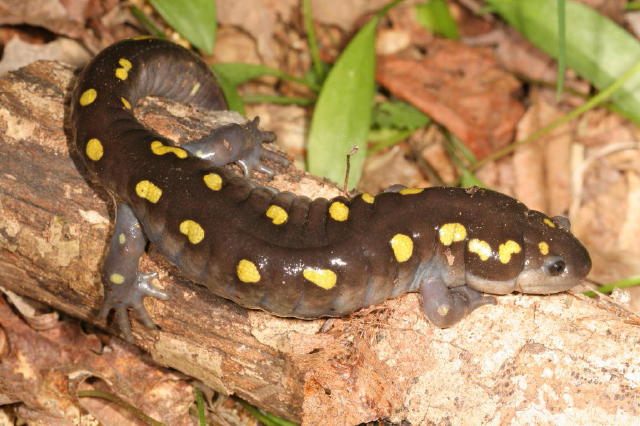
I was working around the vegetable garden (no surprise there), trying to fix the fence when I lifted one of the old boards that helps suppress the weeds. Resting in one of the small-animal (vole?) runways was a Spotted Salamander, and this was a totally unexpected surprise. It's possible the salamander made these tunnels, but looking at its soft, clawless toes, I wonder how.

This species is famous for its mass migrations on the first spring night with a warm rain, usually in late March, but I always miss that event. The salamanders, like other amphibians, are heading for the nearest woodland pond or vernal pool (essentially a temporary puddle in the woods) to lay their eggs before returning to their damp, daytime hiding spots. Vernal pools lack fish - an important consideration in the survival of larval amphibians. The downside is a race against the pool drying out before the transformation of the larvae to a terrestial form.

The only time I've actually seen Spotted Salamanders in the past was uncovering them in the woods with the help of an expert leader at the Allegany Nature Pilgrimage (always the first weekend after Memorial Day when the holiday crowds are gone). That's where these photos were taken.

The Spotted Salamander (Ambystoma maculatum) has a wide range from the lower Mississippi Valley to the Canadain Maritimes. Along with ten other eastern species in the genus Ambystoma, this family of amphibians is referred to as the Mole Salamanders because they stay underground most of their lives.

The Spotted is typically around seven inches long with a heavier build than most salamanders. (The record length is almost 10 inches.) Two rows of yellow spots run down the sides of its dark-brown body from head to tail. It has four toes on each front "arm" and five on each leg in back.

At night, it hunts for a variety of invertebrates including slugs and its favorite food, earthworms. Both of these diet items are in abaundance around our garden. Normally Spotted Salamanders live in moist forests where rotting logs, dead bark and leaf litter provide the right habitat for finding food and hiding. Shade from the tree canopy keeps the ground cooler and reduces drying. What's unusual is that our garden is in the open on top of a hill, quite a walk from the swamp forest at the bottom of the drumlin. Oh well, I guess the salamander knows what it's doing.

Corrections, comments and questions are always welcome at
northeastnaturalist@yahoo.com

Sunday, June 3, 2012

Blue Flag


Blue Flag -- © Dave Spier


The Larger Blue Flag, Iris versicolor, or Fleur-de-lis, is the native alternative to the invasive Yellow Iris. These beautiful perennial herbs are cross-fertilized by honeybees, bumblebees and the Syrphid flies that are often mistaken for bees. In return, the iris provides sustenance in the form of nectar for these insects.

The pollen-producing stamens are hidden inside the iris at the base of the three "falls," the drooping, bluish petals with violet veins curving to the yellow runways that lead to the interior. To get inside, the insects crawl under the arching female styles where pollen is dislodged.

Syrphid fly visiting Larger Blue Flag at
Seneca Meadows Wetland Preserve - © Dave Spier

Several small, long-tongued butterflies have "learned" to bypass the pollen trap and go directly to the nectar between the divisions, thus depriving the iris of cross-pollination.

To learn more about native plants and their role in the environment, visit Habitat Gardening in Central New York, a chapter of Wild Ones: Native Plants, Natural Landscapes, or contact me at northeastnaturalist@yahoo.com Also visit the parallel blog http://adirondacknaturalist.blogspot.com/ for a profile of another wetland species, the Cinnamon Fern.


Wednesday, May 23, 2012

Yellow Iris

Yellow Iris at Allegany State Park in NY (Red House Lake in the background) during the Allegany Nature Pilgrimage -- © Dave Spier


Yellow Iris -- © Dave Spier


Another beautiful alien, this one escaped from water gardens...

Yellow Iris, also called "water flag," grows in the shallow edges of wetlands and ponds where the depth is generally less than 10 inches. It has spread across the United States and you can find a distribution map on the USGS website. Since I live in the Finger Lakes region of New York and travel Route 31, I mostly notice it along sections of the old Erie Canal on my way to the Montezuma Audubon Center.

The scientific name, Iris pseudacorus, comes from Iris, the Greek goddess of the rainbow (referring to the many colors in this family of plants) plus a contraction of the Greek words for "false sweetflag," referring to the similar, sword-like leaves, although sweetflag is actually an arum related to Jack-in-the-pulpit and Skunk-cabbage. Both the iris and the Sweetflag have long-pointed leaves with a prominent mid-rib.

The showy, yellow blossoms - up to four inches across - have three falling sepals surrounding three erect petals. The flowers are held above the leaves by stalks reaching a height of three to four feet. This made the species attractive to horticulturists who brought the plant to the United States in the early 1900's from its native European and North African habitats.

In suitable climates (generally the Southern Sates) it can be used to treat sewage and remove metals from wastewater. Given time this long-lived perennial can form dense, single-plant (monotypic) stands to the detriment of our native wetland plant species. It spreads by using underground rhizomes as well as seeds. Even though associated with wetlands, it can survive a drought up to three months and the seeds can survive a fast wildfire.

Be careful when handling this plant; it's poisonous and can cause skin irritation.

Yellow Iris and leaves at Allegany State Park in NY during the Allegany Nature Pilgrimage -- © Dave Spier

Corrections, comments and questions are always welcome at
northeastnaturalist@yahoo.com 

Thursday, May 17, 2012

Dame's Rocket

Dame's Rocket in front of Yellow Rocket - © Dave Spier

Normally I see it on our way to the Allegany Nature Pilgrimage in southwestern New York the weekend after Memorial Day. It blankets low areas, stream banks, flood plains, woods edges and partially shaded wild areas. Dame's Rocket, Hesperis matronalis, usually peaks around Memorial Day, but it might be early this year. Look for patches of showy wildflowers several feet high with a mix of purple, pink, lavender and nearly-white blossoms. Sometimes a single flower will sport multiple colors or stripes on each petal. The central flower tube generally hides the male and female reproductive parts (stamens and style). Each blossom with its four petals can be nearly an inch across.

Dame's Rocket at the Montezuma Audubon Center
© Dave Spier

Dame’s Rocket is one of many members of the Mustard Family. It arrived here from Eurasia as a garden flower but escaped to the wild and successfully colonized a variety of habitats (a process termed naturalization). In other words, it’s an alien. If you can get past looking at the flowers and smelling their fragrance, you might notice that the alternate, lance-shaped leaves are toothed along the edge and end in long points. Each leaf attaches directly to the main stalk without a leaf-stem (petiole).

Dame's Rocket is sometimes confused with Phlox species which have opposite leaves and five petals.

In case there are no Dame’s Rockets in your neighborhood, there are plenty growing at the Montezuma Audubon Center just north of Savannah, NY. To find out about upcoming programs at the Montezuma Audubon Center, phone (315) 365-3588, send an e-mail, or visit the MAC’s website.  It’s free to just visit the center and walk the trails and look at the wildflowers and birds.

Comments, corrections and questions are always welcome at northeastnaturalist@yahoo.com  The MAC's e-mail address is montezuma@audubon.org