Tuesday, April 19, 2011

Bloodroots


© Dave Spier
 
[First, a note of caution. Many native woodland wildflowers in New York State are protected by law and it is therefore technically illegal to collect them. (Check your own state regulations before picking or collecting.) Before the late 1700's, when much of western and central New York was almost totally covered with forests and wetlands, there was an abundance of habitat for slow-growing wildflowers. All of that changed with the clearing of land to create agricultural fields plus the draining of bogs to create muckland. A 1974 New York conservation law was designed to protect "any plants considered endangered, threatened, rare or exploitably vulnerable." On state land it prohibits anyone from picking, plucking, severing, removing, damaging with defoliants or herbicides, or carrying away any listed plant. (Did they miss any?) On private land, it requires the owner's permission. At most private nature preserves (like Zurich Bog in Wayne County, NY), all collecting is forbidden.]

This brings us to Bloodroot (Sanguinaria canadensis), a member of the Poppy family.  To understand the name of this woodland native, you would need to dig up the entire plant, including the horizontal tuber, but that is illegal -- so we need to take the word of early authors. The scientific genus name, Sanguinaria, comes from the Latin word "sanguis" for blood. The red juice gave the plant several common names including "Indian paint" and "redroot." The Indians called it "puccoon" (or perhaps that is the pioneers' interpretation of their word) and they used the plant medicinally "for swellings, aches, anointing their joints, painting their faces and garments" and an insect repellent. However, the FDA warns that the plant is toxic and should no longer be used under any circumstances.

Bloodroot's single, white flower with its eight (sometimes up to 12) petals quickly fades. A single, lobed leaf grows on a separate stalk from the roots and it continues to produce food to be stored for next spring's spurt of growth before emerging tree leaves make life difficult in the new shade. The showy, white flower has eight to ten petals surrounding the male and female parts, making it possible to self pollinate if there's a shortage of flying insects to carry the pollen. (Since it's one of the earlier woodland wildflowers, that's probably a good policy.) The disk of white petals acts like a solar reflector to concentrate warmth on the yellow stamens and help them ripen. After the seeds ripen, they are supposedly dispersed by ants. Has anyone actually witnessed this locally? If you find of colony of Bloodroots, they are probably clones growing from the rhizome of the original plant.

With the decline in agriculture and the return of many second-growth woodlots, Bloodroot and a few other native wildflowers now seem to be holding their own. The current range of Bloodroot is roughly the eastern 2/3rds of Canada and the U.S.
 
Corrections, comments and questions are always welcome at northeastnaturalist@yahoo.com or connect through my Facebook page and photo page. There's also a community-type page for The Northeast Naturalist. Other nature and geology topics can be found on the parallel blogs Adirondack Naturalist and Heading Out.


Sunday, March 27, 2011

Coltsfoot

Coltsfoot (Tussilago farfara) -- © Dave Spier

At a distance, the flowers resemble dandelions. Close-up, the flowers resemble, well, dandelions. In fact, this alien wildflower is a relative of the dandelion. If it weren’t for the leaves (or more apparently the lack of them in early spring), the yellow flowers of Coltsfoot could pass for dandelions. Both are in the Composite, or Aster, Family.

If you’re inclined to get down on the ground and look at the succulent stem of Coltsfoot, you’ll notice that it is scaly. On the other hand, perhaps you won’t want to get down on the ground because it grows in damp soil along streamsides, banks, ditches, roadsides and waste places. Each plant usually appears as a yellow clump with several flower heads.

The green leaves appear later in spring, after the flowers have gone to seed, and the leaves continue to grow through the summer. Someone thought the leaves, which are somewhat heart-shaped but angular and toothed, resembled a colt’s foot. Don't ask; just use your imagination. They can reach a width of seven inches.

A cough syrup can be made by boiling fresh leaves and adding sugar to the extract according to the Peterson Field Guide to Edible Wild Plants. Dried leaves can be steeped to make tea. If the dried leaves are burned, the ash can be used as a salt substitute.

Corrections, comments and questions are always welcome at
northeastnaturalist@yahoo.com or connect through my Facebook page and photo page. There's also a community-type page for The Northeast Naturalist. Other nature and geology topics can be found on the parallel blogs Adirondack Naturalist and Heading Out.

Monday, January 31, 2011

Winter at Montezuma Audubon Center

Red-bellied Woodpecker (male) by Dave Spier
It’s been pretty quiet and predictable at the Montezuma Audubon Center (MAC) the last few weeks. Below-normal temperatures and a steady influx of snow with periodic breaks has limited trail access to the use of snowshoes. (Bring your own or rent a pair at the center.) Mostly, the same birds have been coming to the feeders each day, but there’s a good mix of Mourning Doves, Downy Woodpeckers, goldfinches, redpolls, House Finches, titmice, a chickadee and one or two White-breasted Nuthatches. One day a male Red-bellied Woodpecker added a touch of color, not from its salmon-colored underside, but its flaming-red crown and nape. I was able to photograph it through the window in the north-end door that overlooks the bird feeders.

[edited in February] The steadily growing length of daylight will begin to trigger changes in wildlife. The weather was better the day after Groundhog Day, with lots of sunshine.  We didn't see a woodchuck, but this is the time when males leave their burrows and search for females before returning underground to await spring.

Winter photography is a matter of staying warm. Dress in layers (always good advice for any outdoor winter activity), but also keep your camera warm by putting it under your coat until needed. If you have one of the larger DSLR cameras with a zoom lens that’s too big to fit under your outerwear, at least carry a spare battery inside a pocket. Cold weather quickly saps battery life. Also carry Q-tips or wipes to remove condensation from the viewfinder when you accidentally breathe on it. Before returning indoors, put the camera inside a plastic bag to control condensation, or so I've read.

If your camera has exposure compensation, read your camera manual to learn how to use this feature. Intentionally overexposing a snowy scene by one or two stops usually gives you a more realistic image. Otherwise you’re likely to end up with gray (instead of white) snow. Turn this camera feature off when you’re done playing in the snow, or your regular photos will be overexposed.

On Wednesday, February 9, I led a morning nature walk at the MAC, but the best part seemed to be the snowshoeing that everyone enjoyed. We trekked through the walnut grove and turned north on Warbler Walk into the hemlock-hardwoods.  Contact northeastnaturalist@yahoo.com


In other news, Sarah Fleming took over from Doug Gorby as Regional Biologist for Ducks Unlimited, which is involved in many of the wetland restoration projects on the Northern Montezuma Wildlife Management Area (WMA) in Savannah. Doug moved to Ohio.

The Montezuma Audubon Center (Route 89 north of Savannah, NY) is in need of volunteers to help with publicity and programs, cataloguing books, caring for the reptiles and other indoor activities. A gardening committee helps with planting native vegetation to benefit wildlife (including attracting more birds) in the spring. For information write to montezuma@audubon.org

For more information about birds and birding in the Montezuma Wetlands Complex, visit the website http://montezumabirding.webs.com/ and for additional birding content, visit http://eatonbirds.webs.com/ (the official website of the Eaton Birding Society, based in Geneva, NY).

Thursday, November 4, 2010

Tall Reeds © Dave Spier


(A very similar version of the article that originally appeared here was re-posted on November 22, 2011 with different photos.)

(For more information about plants, birds and birding in the Montezuma Wetlands Complex and northern Finger Lakes region of New York State, visit the websites for the Montezuma Birding Trail and Eaton Birding Society.  For information about programs at the Montezuma Audubon Center, send them an e-mail, or phone (315) 365-3588.)

Wednesday, September 22, 2010

Bulrushes © Dave Spier

In common usage, the term “bulrush” is applied to a wide variety of generally-aquatic plants related to grasses. In a stricter botanical sense, it is usually reserved for members of the genus Scirpus in the sedge family (Cyperaceae). Grasses are a separate family (Graminae) and rushes are a third (Juncaceae). All together the three plant families comprise the order Poales.

Grasses are distinguished by having hollow stems with “joints” [bulges] where the narrow leaves attach. The flowers are inconspicuous because the plants are wind-pollinated. Sedges, in contrast, have solid stems and many, but not all, are triangular in cross-section. This is the origin of the phrase “sedges have edges.” There are no joints and the leaves may be small or missing. Sedges as a group tolerate wetter and colder growing conditions than grasses. Their ranges extend farther north and they take over where grasses leave off.

One of the common bulrushes in the Montezuma Wetlands Complex is Soft-stem Bulrush, a.k.a. Great Bulrush (Scirpus validus). Its stem is round and spongy, there are no apparent leaves and the seed carriers are brown, cone-shaped nutlets growing in a cluster on the side of the stem below the tip.

This species grows four feet out of the water, and sometimes higher, and bulrush colonies often intermingle with cattails. There’s an accessible patch of bulrushes growing with the cattails around the edge of the two education ponds near the Montezuma Audubon Center (MAC) on Rt. 89 north of Savannah, NY. They are in a low area in the field west of the parking lot and south of the building. The ponds were enlarged and deepened for use by school groups and there’s a footbridge between the two. A large variety of emergent wetland plants including cattails, sedges, arrowheads, bur-reed, Lobelia and other wildflowers grow there. After it rains, high water levels can make the foot bridge across the neck of the pond unstable, so check the stability first or go around the mowed path that circles the main pond.

At least once a month, I lead a general nature hike called “Wednesday Naturalists” at the MAC. We often go past the education pond and take a look at the wetland plants plus the dragonflies that patrol the air and the frogs that hide among the plants.

The MAC also has a monthly series of early morning bird walks and tours. Contact me at northeastnaturalist@yahoo.com for details, or write to montezuma@audubon.org

September features the annual Montezuma Muckrace, a competitive 24-hour birding event to raise funds for projects around the wetlands complex. The 2008 competition raised $12,000, part of which was used to pay for the education pond expansion at MAC. Proceeds from 2009 paid for a Purple Martin house near the MAC and reforestation of 57 acres on the Federal wildlife refuge. For more information, go to http://friendsofmontezuma.org/muck_race.html


Saturday, May 22, 2010

Cattails


© Dave Spier

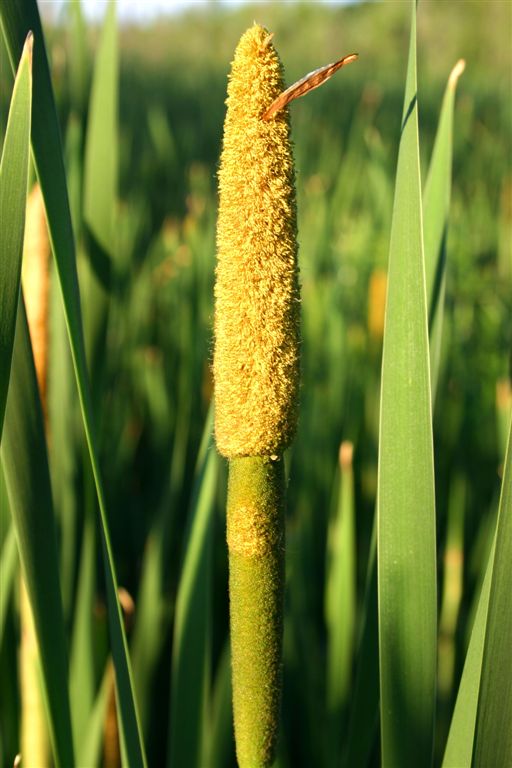
Supermarket, water purifier and wildlife habitat -- take your pick. The cattail is one of nature's most useful and versatile plants. My preference is its edibility. In early summer, the flower spikes produce bright yellow pollen that can be collected in a bag by shaking the heads. After sifting, the protein-rich pollen can be added to wheat flour to make a 50-50 mix. If you're going to store it, thoroughly dry it first. Pollen can also be mixed into pancake batter. Starting at the end of summer, look for horn-shaped sprouts growing on the ends of rootstocks. These can be tossed in a salad or boiled and buttered. They're available until the ground freezes. The starchy core can be used like a potato. During cold weather, the rootstocks become starch-filled as they store food for the long winter. To produce a white flour, wash, peel and then crush the core in cold water. Remove the fibers, allow the starch to settle, pour off the water and dry thoroughly. In early spring, young shoots can be peeled and used like asparagus. Immature flower spikes can be boiled and buttered like corn on the cob.

Because the roots are rich in starch, they were eaten by the Cossacks of Russia. The name carried to England where they are eaten as "Cossack asparagus." On the Pacific coast, cattails are called "Tule-reeds." Sometimes they are mislabeled bulrushes, but that term is properly reserved for a group of sedges which are distant relatives.

Not interested in eating cattails? Then how about water pollution removal? Man-made wetlands containing cattails and other aquatic plants are used to naturally purify sewage water. These systems work best in the South because of the climate, but smaller-scale operations contained in greenhouses work in New York. Some of the research was pioneered at Cornell many years ago. The advantages are low cost and high efficiency. By the time the water reaches the end of the artificial marsh, it's clear and full of macroinvertebrates (tiny animals with external shells). Tiny crustaceans called copepods are indicators of very clean water. Natural marshes continually clean water on a large scale from ice-out to ice-up. Bacteria on the plant roots aid in the process by consuming ammonia, nitrogen, and phosphorus and then breaking down industrial chemicals, detergents, and pesticides into simpler compounds that can be absorbed by the plants.

Many of those artificial outdoor water treatment systems become defacto wildlife refuges and even recreation areas because there are no objectionable odors. Birders are particularly interested in the ducks, swallows, redwings and herons that visit the marshes. But, if you're down South, just watch out for the alligator in the next pond...

It's important to preserve our remaining wetlands and create new ones to replace what's been lost. These low areas store runoff from storms, then filter the water to make it cleaner and recharge underground aquifers. On the surface, they are prime wildlife habitat. For example, muskrats are intricately tied to cattails for food and building materials. Many bird species are adapted to nesting in cattail marshes. Turtles and frogs add to the this wildlife variety. Snow Geese eat the underground stems and roots. Blue and yellow species of iris, purple Pickerelweed and white arrowhead flowers combine to create a garden effect. Red Cardinal Flower and its close relative, blue lobelia, plus pink Swamp Milkweed and yellow Marsh Marigold will grow around the edges. Beware of one problem plant: the invasive Phragmites, or tall reed, which is a dense, aggressive grass that crowds out cattails and reduces the value of wetlands as wildlife habitat.

At one time there were two distinct species of cattails, the Common or Broad-leaved Cattail (Typha latifolia) and the Narrow-leaved Cattail (Typha angustifolia), but now some cattails are hybrids of these two. This is particularly true in the Finger Lakes region where the dominant form, called the "blue cattail," has intermediate-width leaves.

What’s your opinion of cattail marshes? Contact me at northeastnaturalist@yahoo.com If you visit the Montezuma Audubon Center just north of Savannah, NY (in southeastern Wayne County), walk to the small education ponds south of the building, or hike to the western impoundments and investigate the plants and animals growing in the cattail marshes around the perimeters. If you're particularly interested in wetland birds, check out the Eaton Birding Society facebook group or the old website for the Montezuma Birding Trail.

Monday, December 28, 2009

Mockingbirds


© Dave Spier

Mockingbirds now are noted consistently on Christmas Bird Counts in their adopted home of Upstate New York. If there's one common thread, it's probably their association with Multi-flora Rose thickets.

Once considered a southern species, the mockingbird not only has expanded its range northward, but it is now found there year-round, in large part due to the widespread presence of Multi-flora Rose bushes and their small, bite-size fruits. Mockers reportedly defend fruit trees and berry bushes in their winter territory, but I have yet to see this. Cedar Waxwings, which can strip a tree or shrub of its fruits in hours are particularly prone to being attacked by mockingbirds. Have you ever witnessed this behavior? Mockers, which are larger, have been reported going so far as killing waxwings by pecking them to death.

The Northern Mockingbird (Mimus polyglottos) is most noted for its talent of imitating other bird calls. Each sound is repeated three or more times before moving on to a different song from its repertoire. Not being content to stop there, it also accurately mimics sirens, musical instruments, squeaky hinges, burglar alarms and other urban sounds. During the breeding season and even into the fall, this serenade can last into the night. Native Americans named it “cencontlatolly,” meaning “400 tongues.” Mimus polyglottos means “mimic of many-tongues.”

Mockers are most attractive in flight when their dark wings flash prominent white patches. At rest, a bit of the white still shows. Their long tails are also dark and edged in white. Otherwise, the birds are gray on top and light underneath. In size and shape, mockingbirds are similar to their relatives, the catbirds and thrashers.


Corrections, comments and questions are always welcome at northeastnaturalist@yahoo.com or connect through my Facebook page and photo page. Other nature and geology topics can be found on the parallel blogs Adirondack Naturalist and Heading Out. There's also a community-type page for The Northeast Naturalist.