(A very similar version of the article that originally appeared here was re-posted on November 22, 2011 with different photos.)
primarily the Northeast U.S., but many of the species, especially birds, range far beyond this region
Thursday, November 4, 2010
Tall Reeds © Dave Spier
(A very similar version of the article that originally appeared here was re-posted on November 22, 2011 with different photos.)
Wednesday, September 22, 2010
Bulrushes © Dave Spier
Grasses are distinguished by having hollow stems with “joints” [bulges] where the narrow leaves attach. The flowers are inconspicuous because the plants are wind-pollinated. Sedges, in contrast, have solid stems and many, but not all, are triangular in cross-section. This is the origin of the phrase “sedges have edges.” There are no joints and the leaves may be small or missing. Sedges as a group tolerate wetter and colder growing conditions than grasses. Their ranges extend farther north and they take over where grasses leave off.
One of the common bulrushes in the Montezuma Wetlands Complex is Soft-stem Bulrush, a.k.a. Great Bulrush (Scirpus validus). Its stem is round and spongy, there are no apparent leaves and the seed carriers are brown, cone-shaped nutlets growing in a cluster on the side of the stem below the tip.
This species grows four feet out of the water, and sometimes higher, and bulrush colonies often intermingle with cattails. There’s an accessible patch of bulrushes growing with the cattails around the edge of the two education ponds near the Montezuma Audubon Center (MAC) on Rt. 89 north of Savannah, NY. They are in a low area in the field west of the parking lot and south of the building. The ponds were enlarged and deepened for use by school groups and there’s a footbridge between the two. A large variety of emergent wetland plants including cattails, sedges, arrowheads, bur-reed, Lobelia and other wildflowers grow there. After it rains, high water levels can make the foot bridge across the neck of the pond unstable, so check the stability first or go around the mowed path that circles the main pond.
At least once a month, I lead a general nature hike called “Wednesday Naturalists” at the MAC. We often go past the education pond and take a look at the wetland plants plus the dragonflies that patrol the air and the frogs that hide among the plants.
The MAC also has a monthly series of early morning bird walks and tours. Contact me at northeastnaturalist@yahoo.com for details, or write to montezuma@audubon.org
September features the annual Montezuma Muckrace, a competitive 24-hour birding event to raise funds for projects around the wetlands complex. The 2008 competition raised $12,000, part of which was used to pay for the education pond expansion at MAC. Proceeds from 2009 paid for a Purple Martin house near the MAC and reforestation of 57 acres on the Federal wildlife refuge. For more information, go to http://friendsofmontezuma.org/muck_race.html
Saturday, May 22, 2010
Cattails
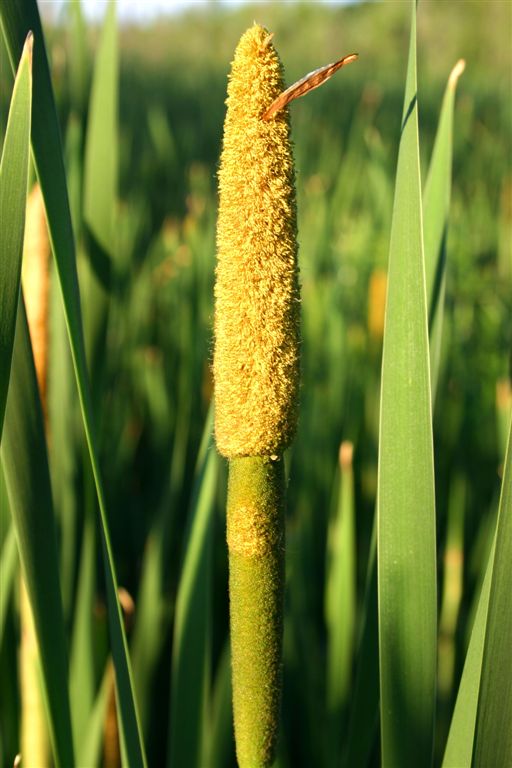
Supermarket, water purifier and wildlife habitat -- take your pick. The cattail is one of nature's most useful and versatile plants. My preference is its edibility. In early summer, the flower spikes produce bright yellow pollen that can be collected in a bag by shaking the heads. After sifting, the protein-rich pollen can be added to wheat flour to make a 50-50 mix. If you're going to store it, thoroughly dry it first. Pollen can also be mixed into pancake batter. Starting at the end of summer, look for horn-shaped sprouts growing on the ends of rootstocks. These can be tossed in a salad or boiled and buttered. They're available until the ground freezes. The starchy core can be used like a potato. During cold weather, the rootstocks become starch-filled as they store food for the long winter. To produce a white flour, wash, peel and then crush the core in cold water. Remove the fibers, allow the starch to settle, pour off the water and dry thoroughly. In early spring, young shoots can be peeled and used like asparagus. Immature flower spikes can be boiled and buttered like corn on the cob.
Because the roots are rich in starch, they were eaten by the Cossacks of Russia. The name carried to England where they are eaten as "Cossack asparagus." On the Pacific coast, cattails are called "Tule-reeds." Sometimes they are mislabeled bulrushes, but that term is properly reserved for a group of sedges which are distant relatives.Not interested in eating cattails? Then how about water pollution removal? Man-made wetlands containing cattails and other aquatic plants are used to naturally purify sewage water. These systems work best in the South because of the climate, but smaller-scale operations contained in greenhouses work in New York. Some of the research was pioneered at Cornell many years ago. The advantages are low cost and high efficiency. By the time the water reaches the end of the artificial marsh, it's clear and full of macroinvertebrates (tiny animals with external shells). Tiny crustaceans called copepods are indicators of very clean water. Natural marshes continually clean water on a large scale from ice-out to ice-up. Bacteria on the plant roots aid in the process by consuming ammonia, nitrogen, and phosphorus and then breaking down industrial chemicals, detergents, and pesticides into simpler compounds that can be absorbed by the plants.
Many of those artificial outdoor water treatment systems become defacto wildlife refuges and even recreation areas because there are no objectionable odors. Birders are particularly interested in the ducks, swallows, redwings and herons that visit the marshes. But, if you're down South, just watch out for the alligator in the next pond...
It's important to preserve our remaining wetlands and create new ones to replace what's been lost. These low areas store runoff from storms, then filter the water to make it cleaner and recharge underground aquifers. On the surface, they are prime wildlife habitat. For example, muskrats are intricately tied to cattails for food and building materials. Many bird species are adapted to nesting in cattail marshes. Turtles and frogs add to the this wildlife variety. Snow Geese eat the underground stems and roots. Blue and yellow species of iris, purple Pickerelweed and white arrowhead flowers combine to create a garden effect. Red Cardinal Flower and its close relative, blue lobelia, plus pink Swamp Milkweed and yellow Marsh Marigold will grow around the edges. Beware of one problem plant: the invasive Phragmites, or tall reed, which is a dense, aggressive grass that crowds out cattails and reduces the value of wetlands as wildlife habitat.
At one time there were two distinct species of cattails, the Common or Broad-leaved Cattail (Typha latifolia) and the Narrow-leaved Cattail (Typha angustifolia), but now some cattails are hybrids of these two. This is particularly true in the Finger Lakes region where the dominant form, called the "blue cattail," has intermediate-width leaves.
What’s your opinion of cattail marshes? Contact me at northeastnaturalist@yahoo.com If you visit the Montezuma Audubon Center just north of Savannah, NY (in southeastern Wayne County), walk to the small education ponds south of the building, or hike to the western impoundments and investigate the plants and animals growing in the cattail marshes around the perimeters. If you're particularly interested in wetland birds, check out the Eaton Birding Society facebook group or the old website for the Montezuma Birding Trail.Monday, December 28, 2009
Mockingbirds
.jpg)
Mockingbirds now are noted consistently on Christmas Bird Counts in their adopted home of Upstate New York. If there's one common thread, it's probably their association with Multi-flora Rose thickets.
Once considered a southern species, the mockingbird not only has expanded its range northward, but it is now found there year-round, in large part due to the widespread presence of Multi-flora Rose bushes and their small, bite-size fruits. Mockers reportedly defend fruit trees and berry bushes in their winter territory, but I have yet to see this. Cedar Waxwings, which can strip a tree or shrub of its fruits in hours are particularly prone to being attacked by mockingbirds. Have you ever witnessed this behavior? Mockers, which are larger, have been reported going so far as killing waxwings by pecking them to death.
The Northern Mockingbird (Mimus polyglottos) is most noted for its talent of imitating other bird calls. Each sound is repeated three or more times before moving on to a different song from its repertoire. Not being content to stop there, it also accurately mimics sirens, musical instruments, squeaky hinges, burglar alarms and other urban sounds. During the breeding season and even into the fall, this serenade can last into the night. Native Americans named it “cencontlatolly,” meaning “400 tongues.” Mimus polyglottos means “mimic of many-tongues.”
Mockers are most attractive in flight when their dark wings flash prominent white patches. At rest, a bit of the white still shows. Their long tails are also dark and edged in white. Otherwise, the birds are gray on top and light underneath. In size and shape, mockingbirds are similar to their relatives, the catbirds and thrashers.
.jpg)
Friday, June 26, 2009
Jacks and Jills
Many people recognize Jack-in-the-pulpit (Arisaema sp.) as a native spring woodland wildflower, but how many can tell which ones are Jill’s? It's actually simple, but we'll get to that later. The plant is in the Arum family and therefore related to Skunk-cabbage, plus Arrow Arum, Sweetflag and Green Dragon. Most of these species have their flowers inside a hood (called a spathe). In the case of Jack (or Jill) the club-shaped spadix resembles a preacher in his canopied pulpit. The actual flowers are tiny and hidden at the base of the spadix, inside the bottom of the hood. Male (staminate) and female (pistillate) flowers are on separate plants. Now, consider that it takes much more energy to be a female than a male. Pollen production is a short-term process that soon ends, but nourishing seeds takes the remainder of the summer until they ripen and turn bright scarlet red. Does this give you any clues? Female plants are larger and almost always have two leaves while male plants are smaller and have one leaf. But hold on, we're not done yet. The same plant can change back and forth depending on growing conditions!
Like many woodland wildflowers it takes a number of years for an individual plant to reach sexual maturity and begin flowering. Life is tough in the woods. Most of the growing season is spent in the shade of larger plants, primarily trees. It takes time, years of time, to store enough food (energy) underground to meet the added burden of producing flowers. Jack-in-the-pulpits start life as a single, small, compound leaf that grows larger each year until it has enough energy to add a male flower. If life is good, it eventually stores enough food to produce a female flower the following year. This usually takes three to five years. If conditions deteriorate -- there's not enough sunlight or not enough rain or it's too cold -- the plant can go back to being a male and start the process all over again.
Depending on which botanist you consult, there are either three species of Jack-in-the-pulpit or simply three varieties within one species, Arisaema triphyllum. I suspect that some of the confusion comes from the sexual variability within any given population. Aside from that there are variations in physical appearance. Some Jacks have green hoods, others have white-striped green hoods and a third variety has purple hoods usually with light stripes. The leaves are always three-parted and long-stalked. Some varieties can grow a foot high, while others reach three feet. This may be partly a result of soil fertility. The plants generally grow in moist woodlands, often at the edge of a swamp.
![]() |
| Jack-in-the-pulpit fruits ("berry" cluster) in late summer |
This plant is also known as Indian turnip, but be warned that the underground corm contains crystals of calcium oxalate which cause an intense burning sensation in the mouth. There's a way around this but take pity on the hard life of the Jack and leave it to grow another year. If you really want to experiment with wild foods, use the plentiful Skunk-cabbage, but email me [linked below] for precautions and details. If you happen to stop at the Montezuma Audubon Center in Savannah, NY, and hike the Warbler Walk trail, you can take a look at both the Jack-in-the-pulpit and the Skunk-cabbage.
![]() |
| one of my first encounter with a Jack-in-the-pulpit in the late 60's or early 70's (all of the spring shots are scanned from slides) |
(This copyrighted article and the first photo appeared in the May 24, 2009 issue of the Times of Wayne County. All rights reserved.)
Saturday, April 4, 2009
Skunk-cabbage
© Dave Spier
![]() |
| Part of the spathe removed to show the actual flower inside... |
...and a related west-coast species called American Skunkcabbage:
Send your comments, questions, or suggestions to Dave Spier, northeastnaturalist@yahoo.com or request hyperlinks to my photo websites. There's a link to my Facebook page at the bottom of the right sidebar.
Sunday, March 8, 2009
March Trails - the Wetlands
DaveSpier_D015885t_1.jpg)
© 2009 Dave Spier
The change from winter to spring, as much as we'd like it to be a one-way continuum, is never that simple. It would be great if one day it was winter -- and the next day it was spring -- and there was no going back. Instead it's a push and pull seesaw of alternating warm and cold air. A warm front one day is followed by a cold front the next, and then it reverses itself again. Temperatures go up and down, but on the average we drift toward spring.
Since meteorologists keep records on a monthly basis, spring for them begins on March 1. Meteorological winter was December, January and February, the three coldest months of the year. At the opposite end, meteorological summer is June through August, the warmest months. When we speak of spring beginning on March 20, the vernal equinox, we are speaking of astronomical spring when day and night are equal lengths.
Physical weather changes in March trigger biological changes, so we might say that biological spring also begins March 1. The two are closely tied. Even though thousands of Canada Geese wintered on the Finger Lakes, tens of thousands more return from the Chesapeake Bay at the end of February every year. For them, it's spring. Similarly large numbers of Snow Geese are now returning, too.
When the ice melts, walk down to the local pond and watch for the resident Mallards to return. To save time, they formed pair bonds last fall and now they're ready to go. They'll also be checking out grassy puddles in the corners of fields. Unless she's swimming with the drake, you may not notice the drab-colored hen. Her brown-mottled plumage is camouflage to blend with the dead vegetation as she picks a nest site.
Mallards have to share their wetland and field habitats with the Ring-billed Gull, named for the dark band near the tip of the adult's bill. (For once ornithologists made the name accurate and simple.) Gulls are primarily scavengers and their main food is dead fish, but in the spring they move inland and feed on worms, insects and other bits of food gleaned from fields. When not feeding they rest on the meltwater puddles that collect in low depressions. These are only temporary and when they dry out the gulls will return to the lakes. By then the baitfish should have returned to the shallows.
Many ponds are bordered by cattail marshes, still beige from the winter. The exposed edges were matted by snow and wind, but the denser interior is more self-supporting and provides perches for the male Red-winged Blackbirds returning from the south. They flare their red shoulder patches as they sing "kong-ka-reeee," a warning to other males that "this is my turf." In another week or two, the females, which look more like large, brown-streaked sparrows, but with pointier bills, will join the males and begin pairing and preparing for nest building.
Cattail marshes are important storage pools for spring flood waters and they deserve protection for this reason alone. By slowing the runoff, they allow underground aquifers to be recharged. The third benefit is serving as wildlife habitat for waterfowl and muskrats plus secretive animals that we seldom see but sometimes hear.
On slightly higher ground, where it dries out during the summer, willows and Red-osier Dogwood take over. For a sure sign of spring, look in these swampy borders for Pussy Willows, a shrub that seldom exceeds 15 feet in height. The soft, gray-fuzzy buds are really male flowers that later turn yellow with pollen. Since the buds were originally formed at the end of last summer, their only protection through the winter was a single, brown bud scale which gets pushed back as the bud opens. Red-winged Blackbirds looking for a higher singing perch might choose the Pussy Willow.
Another wetland shrub related to willows is the Speckled Alder. More common in the Adirondacks than western New York, it's in the same family as birches, musclewood and hazelnut. Look for the transverse, whitish lenticels on smooth, dark bark. It's a favorite food of the Beaver.
Now look down at your feet and search for the Skunk-cabbage that often grows in this same habitat. A long, starchy tap root fuels their spring growth as they chemically generate heat to melt through any remaining snow and to woft their odors to the first flies emerging from dormancy.
In spite of temperatures in the teens this morning, there are two Red-winged Blackbirds singing from the top of the Silver Maple in the backyard. Normally a tree of the bottomland swamps, this one was probably planted. In about two weeks, the red flower buds will open and release their wind-blown pollen. The timing is risky because that is often when we get ice storms. Warm, moist air trying to return from the south over-runs cold air on the ground and falling rain freezes when it contacts anything below 32° F. (0° C.) The upper trunk and branches -- smooth, gray and brittle -- are easily broken by the weight of glaze ice.


DaveSpier_2.jpg)


DaveSpier_1.jpg)