Friday, June 28, 2013

Black Elderberry

Elder usually has seven sharply-toothed leaflets,
but the number can vary from five to 11.
© Dave Spier

Common Elder, a.k.a. Black Elderberry (Sambucus canadensis, syn. Sambucus nigra, ssp. canadensis) is a native member of the Honeysuckle family. Beyond the opposite, pinnately-compound leaves, there's little resemblence to indicate the relationship. 

Numerous, small, white flowers are crowded into flat-topped terminal disks that are conspicuous in late June and early July in New York. The flower clusters can be dipped in batter and deep-fried like fritters, or wait for the dark-purple, juicy berries to ripen and make a pie. The dark fruits give the shrub it's alternate name, American Black Elderberry. Aside from the mentioned edibility, take note that the leaves, twigs, roots and unripe fruit are toxic due to cyanogenic glycoside and alkaloid.

The woody stems contain white pith that can be removed in order to make a flute or whistle. This musical quality is the basis of the genus name; in ancient Greece, sambuce was a musical instrument. Given the toxicity of the stems, though, I'd rethink this use for the plant.

Common Elder's range spans all of the southern states from California to Florida, north across most of the Lower 48 (except the Great Basin and Pacific Northwest) and continues north into eastern Canada. There's a range map on the USDA Plants Database. Many of the states have more detailed maps down to the county level. For example, the opening photo was taken at Newtown Battlefield State Park, near Elmira, NY, but the shrub occurs in other scattered locations across New York State.

This elderberry seems to require more sunlight than it's woodland cousin the Red-berried Elder, so look for the purple-fruited species on the edge of woods, usually in lowland spots where there is extra soil moisture, although I would not describe it as a true wetland species because of its low anaerobic tolerance. We live on top of a drumlin ridge and a Common Elder has "volunteered" to grow behind the garage where it is somewhat sunny, at least part of the day. We can assume the original seed was dropped by a bird. A number of species including robins, catbirds and waxwings are berry eaters. I'd be interested in knowing whether elderberry grows near you.

Corrections, comments and questions are always welcome at northeastnaturalist@yahoo.com or connect through my Facebook page and photo page. There's also a community-type page for The Northeast Naturalist. Other nature and geology topics can be found on the parallel blogs Adirondack Naturalist and Heading Out.

Wednesday, June 12, 2013

Yellow Warblers


Many warblers have at least some yellow, but I imagine if there's one that deserves the name of the color, it's the Yellow Warbler (Setophaga petechia).

The spring migration has come and gone, and now we have to be content with the summer residents that remain. Robins seem to be everywhere, and unfortunately so are the starlings and grackles. High in the tree tops, you might hear an oriole; they seem to prefer big cottonwoods here. If you have orioles near you, what trees do they prefer?  Orioles can be relatively common, but seldom do we get a good look at the male's flashy orange and black.
 

male Yellow Warbler at the Allegany Nature Pilgrimage (southwestern New York,
always the first weekend after Memorial Day) during a bird-banding demonstration

Another colorful songster, though relatively common, is likely to be overlooked unless you’re in the habit of scanning shrubby wetlands and thickets while listening for its "sweet, sweet, sweeter than sweet" song. Check the tops of shrubs and dwarf willows for a bright but tiny spot of yellow. With binoculars, look for rusty-red streaking on the breast. This is the male Yellow Warbler, one of 51 North American species of wood warblers – many of which are now uncommon or quickly pass through on their way north. The Yellow Warbler on the other hand is relatively common and a widespread nester from coast to coast across the northern 2/3rds of the U.S., Alaska and most of Canada with breeding populations extending down through coastal California and central Mexico. (If you're submitting an eBird report, you can use the "Add Details" button, and then the "Breeding Code" button to record any breeding behavior you observe or hear.)
 

female Yellow Warbler at Montezuma National Wildlife Refuge, NY

Warblers are small birds, generally four to five inches long, with slender, straight-pointed bills used like tweezers to collect insects. Warblers are very active and it’s hard to get a good look at any of them. Most prefer woodlands in various stages of growth from scrub to mature forest and for this reason they are referred to as wood warblers. Within these habitats, some warblers stay in the treetops (giving birders "warbler neck"), some hide on the ground and the majority travel in-between. Yellow Warblers are somewhat unusual in preferring more open settings. Willow thickets and isolated shrubs in cattail marshes seem more to their liking, but any thicket will do in a pinch.

male Yellow Warbler checking its reflection for a rival in our camper window

The Yellow Warbler is a common summer resident that begins returning at the end of April. The remainder trickles in throughout May. Aptly named, they are yellow on the head and underneath, olive-yellow on the back, and a mix of olive and yellow on the wings. Males are brighter with reddish streaks on the breast. The more aggressive and dominant males have darker streaks. Females are duller with faint rusty streaks on the sides. If you get a close view, look for yellow tail spots that are usually missed.

Brown-headed Cowbird egg in Yellow Warbler nest (Bradford County, PA)

The Yellow Warbler is one of the species most frequently parasitized by cowbirds, but they have developed a defensive strategy against the blackbirds. After a cowbird egg is deposited, the Yellow Warbler builds a new nest on top of the old and lays a new batch of their own eggs. If the cowbird returns, the warbler repeats the process. The record is a six-story nest (although there is an unconfirmed report of a 10-story nest near Cayuga Lake, NY, in 1923).

As a species, the Yellow Warbler is perhaps the most widespread of the warblers, but there are three distinct groups with four subspecies. Together they span the continent and range from the Arctic down through Mexico and the Caribbean to the northern reaches of South America. You can find an interactive range map on eBird.
 
pair of Yellow Warblers at Montezuma National Wildlife Refuge, NY

On their territories, Yellow Warblers sing two types of songs with a number of individual variations. One song type is used to attract a mate, while the other is used to defend territories against other males. With wetlands being a limited resource, there is intense competition for prime nesting space. After mating, recognition of individuals becomes important, so minor variations in songs become important. You can find more information along with a static range map and recordings of Yellow Warbler songs on All About Birds.
 

Yellow Warblers have only one brood per year and as soon as the young are independent, the species begins its southward migration. They are one of the earliest summer nesters to leave. Some are gone by the end of July and (almost) all have left by the time goldenrod is in full bloom.

Corrections, comments and questions are always welcome at northeastnaturalist@yahoo.com or connect through my Facebook page and photo page. There's also a community-type page for The Northeast Naturalist. Other nature and geology topics can be found on the parallel blogs Adirondack Naturalist and Heading Out.

Wednesday, June 5, 2013

Dame's Rocket


Dame’s Rocket (Hesperis matronalis) is another invasive alien, albeit an attractive one, in the mustard family. It is now widespread along roadsides, woods edges and damp thickets, but it started as a garden escape after it was introduced from Eurasia. (There's a range map on the USDA Plants Database.) Many years ago, we tried growing it on our dry hilltop, but it never took hold (probably a good thing in retro-spect), so look for it in lower areas with partial shade. It seems to prefer moist soil but avoids true wetlands.  As an example, at the Montezuma Audubon Center, it grows throughout the walnut grove and around the edges, but it’s generally absent from the open fields.


Also known as Purple Rocket, this biennial or short-lived perennial herb comes in a range of colors from pale lavender to hot pink and purple. All of the blossoms on an individual plant are usually the same color, but adjacent plants may vary widely. Light and dark colors are often mixed together in the same vicinity and sometimes you’ll find flowers with white streaks on purple petals. Rarely, several colors are mixed on the same flower. The four petals make an “X” or cross, which is characteristic of the mustards (the Brassicaceae, formerly Cruciferae). At first glance it resembles Phlox, but Phlox has five petals (the same as the number of letters in its name).

Dame's Rocket in front of Yellow Rocket (Common Winter Cress, Barbarea vulgaris)

The purple variety of Dame’s Rocket generally produces more seeds per plant and seems to be the dominant color. The stalked seed pods are thin and erect and split open when ripe. The plant usually grows several feet tall. The lance-shaped leaves are long-pointed, toothed along the margins and they alternate (i.e., are not opposite) along the hairy main stem below the flower and seed clusters.

more of the complete Dame's Rocket plant showing some of the leaves

The best time to enjoy this plant may be when it’s backlit by the afternoon sun. In the evening it gives off a lovely fragrance, probably timed to specific pollinators that rest during the day. This is reflected in another common name for the plant, the night-scented gilliflower. The scientific genus name, Hesperis, is Greek for evening.

Corrections, comments and questions are always welcome at northeastnaturalist@yahoo.com or connect through my Facebook page and photo page. There's also a community-type page for The Northeast Naturalist. Other nature and geology topics can be found on the parallel blogs Adirondack Naturalist and Heading Out.

Tuesday, May 28, 2013

Celandine

© Dave Spier

Celandine, Chelidonium majus, is a somewhat invasive alien with attractive yellow flowers arranged in an umbel (think inside-out umbrella), although the blossoms tend to open one at a time. Each showy flower has four petals. Black seeds growing in long capsules continue the superficial resemblance to mustards, but Celandine is actually in the Poppy family, although it's different than Celandine Poppy, a more Western native species. Celandine's somewhat grayish-green, compound leaves are irregularly lobed and scallop-edged.

This species is often called Greater Celandine to distinguish it from Lesser Celandine, Ranunculus ficaria, a quite different plant in the Buttercup family.

You can find a range map on the USDA plants database website. Celandine is widespread in the Midwest, Northeast, Eastern Canada plus outlier states like GA, NE, UT, MT, WA and adjacent BC. Clicking on some of the states will give you more refined maps down to the county level. For example, clicking NY will show Celandine's distribution across the Finger Lakes. It appears to be missing from Schuyler County, but I have photographed it in Wayne County, so that omission is an error.

When broken, Celandine's stems exude a somewhat-poisonous yellow latex that can cause dermatitis or eye irritation in sensitive individuals. A final note of warning -- Celandine is toxic due to a range of isoquinoline alkaloids so avoid ingesting the plant, and wear protection if you're pulling the plant to remove it.

Corrections, comments and questions are always welcome at northeastnaturalist@yahoo.com or connect through my Facebook page and photo page. There's also a community-type page for The Northeast Naturalist. 

Friday, May 24, 2013

Rhododendron


Great Rhododendrons (Rhododendron maximum) grow wild in scattered colonies across New York and New England as far as southwestern Maine, but it's found primarily in the Appalachians from Pennsylvania to northern Georgia. Beyond that it has been widely planted as an ornamental. Wherever there is sufficient moisture, these evergreen members of the heath family can form dense thickets generally reaching a height of 13 feet, but old bushes are capable of growing to a height of 30 or even 40 feet and a crown diameter of 12 feet, essentially becoming small trees. The main requirement is acidic soil with a high organic content.

The concave leaves are long and leathery and curve down to smooth edges that may curl under during dry or cold weather. Most of the leaves are clustered in whorls around the end of twigs and surround the showy, rose-pink to purple, sometimes white, flower clusters that open between March and August, depending on the local climate. Our ornamental version opens in late May here in the northern Finger Lakes region.


In the wild, rhododendron is an understory plant and does well in the shade of taller trees. Combine that factor with the shrub's dense, evergreen foliage and you can understand why it's difficult for smaller plants and wildflowers to grow underneath rhododendrons.

This species has a number of alternate common names including Late or Summer Rhododendron, Great, Bigleaf or Deertongue Laurel and Rosebay. It's the state flower of West Virginia. The name Mountain Laurel is reserved for its smaller relative, Kalmia latifolia.


Corrections, comments and questions are always welcome at

northeastnaturalist@yahoo.com or connect through my Facebook page and photo page. There's also a community-type page for The Northeast Naturalist. Other nature and geology topics can be found on the parallel blogs Adirondack Naturalist and Heading Out.

Saturday, May 11, 2013

Shagbark Hickory

emerging hickory leaves can sometimes resemble praying hands
 © Dave Spier

A week of warm weather has created a green paradise in the northern Finger Lakes region of New York. Among the many transformed deciduous trees, the Shagbark Hickory (Carya ovata) leaves have emerged. When the giant bud scales first peeled open, the "fingers" of miniature leaves resembled "praying hands." Once fully opened, the hickory's feather-compound leaves become distinctive. There are five (sometimes seven) leaflets with four opposite and one at the tip. The smallest are the inner, the middle pair are larger and the terminal leaflet is the largest. All are toothed and long-pointed. By the time it's done growing, a compound leaf can reach over a foot in length.

young hickory leaves unfolded and growing


hickory flowers are wind pollinated

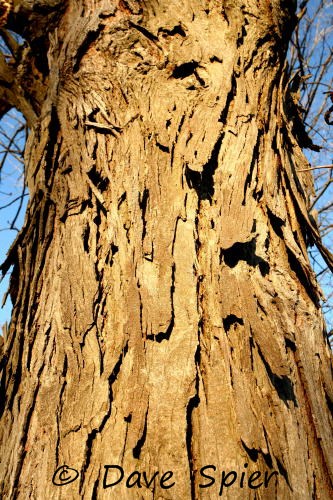
Shagbarks, aptly named for the long, peeling shreds of bark, can easily grow to a height of 60 to 90 feet. The record is 120 feet. The wood is strong and elastic and was once prized for tool handles, gunstocks, skis and chair backs. When burned, it gives off a lot of heat and makes high-grade charcoal.

Shagbark Hickory bark
In late summer and early fall, the thick-walled nut husks split into four sections and release the four-ridged nuts which are good to eat. (Squirrels, possums, Wild Turkeys and Wood Ducks would agree.) The nuts also can be ground in a meal-like flour or crushed and boiled to separate the oil. Rabbits and deer browse the twigs. In late winter, the trunks can be tapped in the manner of collecting maple sap.

child holding hickory nuts, some with the husk on (Bayberry Environmental Education Center, Junius, NY, when I was a naturalist there)

Hickories are related to walnuts and butternuts (Juglans spp.) which have numerous leaflets, all roughly the same size. All these trees are in the same family (Juglandaceae) along with pecans.


Corrections, comments and questions are always welcome at northeastnaturalist@yahoo.com or connect through my Facebook page and photo page. There's also a community-type page for The Northeast Naturalist. Other nature and geology topics can be found on the parallel blogs Adirondack Naturalist and Heading Out.

Wednesday, May 8, 2013

Wild Geraniums


A true member of the Geranium family, the wild variety has small clusters of flowers with five showy, rose-pink petals. After the petals fall, a long "beak" remains and gives geraniums the nickname "cranesbill." The Greek word for crane is geranos, which is the root of our common name, geranium. The wild one is also called spotted crane flower, but the reason for "spotted" eludes me.

Growing one to two feet tall, Wild Geraniums (Geranium maculatum) are found in woods and shady roadsides, often near streams, from Maine to Georgia and west to Arkansas and Manitoba. The attractive, soft-green, hairy leaves are deeply divided into five (sometimes 3-7) radial lobes reminiscent of Silver Maple leaves.

The roots are rich in tannin and were once used in folk medicine to treat a variety of ailments. This earned the plant the name astringent-root.
With attractive flowers that are 1-1.5 inches in diameter, the plant rates a place in ornamental gardens. Wild Geraniums are now available commercially, as are many native wildflowers.

Corrections, comments and questions are always welcome at northeastnaturalist@yahoo.com or connect through my Facebook page and photo page. There's also a community-type page for The Northeast Naturalist. Other nature and geology topics can be found on the parallel blogs Adirondack Naturalist and Heading Out.